Forest Coloring Pages
15 free printable pages, ready to download and print.
Create a Custom Coloring Page
Describe what you'd like and we'll generate it free, no account needed
Family-friendly only · 1 free per day
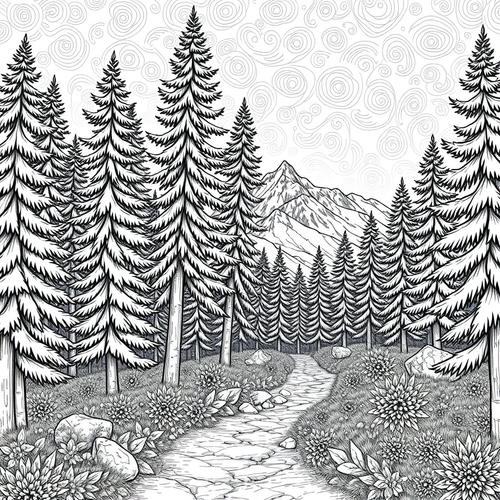


A forest is mostly one problem repeated: how to suggest hundreds of leaves without drawing hundreds of leaves. The answer is layers of value rather than detail, the canopy darkest where it is dense, lightest where the sun gets through, and these 15 forest coloring pages give you every version of that problem, from a redwood stand shot through with sunbeams to a moonlit wood full of fireflies. Every design downloads as a free printable PDF sized for US Letter paper.
Simple sheets keep the masses broad. Ancient Redwood Forest With Sunbeams, Misty Mountain Forest in Morning Light and Forest Path Covered in Colorful Autumn Leaves are the most approachable. Detailed sheets go dense: Forest at Night With Moonlight and Fireflies, Fallen Log Covered in Moss and Tiny Wildflowers and Rainforest Canopy With Exotic Birds are long projects.
Depth is the whole trick on a forest page. Color the nearest trees with the strongest contrast and the sharpest edges, then make everything further back progressively lighter, cooler and grayer. Trees at the treeline should be a pale blue-gray with almost no detail. It feels like giving up on the background, and it is exactly what makes the foreground read as close.
Several sheets put an animal into the trees, which changes the job: the forest becomes background and has to stay quieter than the subject. Deer in a Peaceful Forest Glade, Owl Family in a Hollow Old Oak Tree and Forest Animals Gathered in a Sunlit Clearing all benefit from muted greens, with the strongest color saved for fur and feathers. Winter Forest With Snow-Covered Trees and Footprints drops the green problem entirely and becomes an exercise in blue shadow on white. Forest Stream With Mossy Rocks and Ferns and Pine Forest Path With Mountain Backdrop are the two best pages for practicing aerial perspective on one sheet.
Related sets: Waterfalls, Mushrooms and Wolves.
Frequently Asked Questions
How do you make a forest look deep instead of flat?
Reduce contrast with distance. The nearest trunks get the darkest darks, the lightest lights and crisp edges; each layer behind gets lighter, cooler and softer, until the furthest trees are a barely-there blue-gray. This is aerial perspective, and it works because atmosphere genuinely does scatter light over distance.
How do you color sunbeams coming through trees?
Leave them as bare paper. Decide the angle before you start, then keep those diagonal bands uncolored while you shade everything around them, going darkest immediately alongside each beam. Coloring a beam yellow almost never works, a shaft of light reads as light only because everything next to it is dark.
What greens should I use for trees?
At least three, and not straight from the tin. A yellow-green for sunlit foliage, a mid green for the general mass, and a blue-green or gray-green for shadow and distance. Adding a little brown or ochre to the mid green keeps it from looking artificial, since real foliage is rarely a pure green.
Which forest pages suit children?
The redwood, misty mountain and autumn path sheets have the largest open shapes. The bamboo forest is also straightforward and rewarding, since the vertical stalks are simple to fill. The mossy log and the rainforest canopy are the most detailed and suit adults or older children.