Knight Coloring Pages
15 free printable pages, ready to download and print.
Create a Custom Coloring Page
Describe what you'd like and we'll generate it free, no account needed
Family-friendly only · 1 free per day


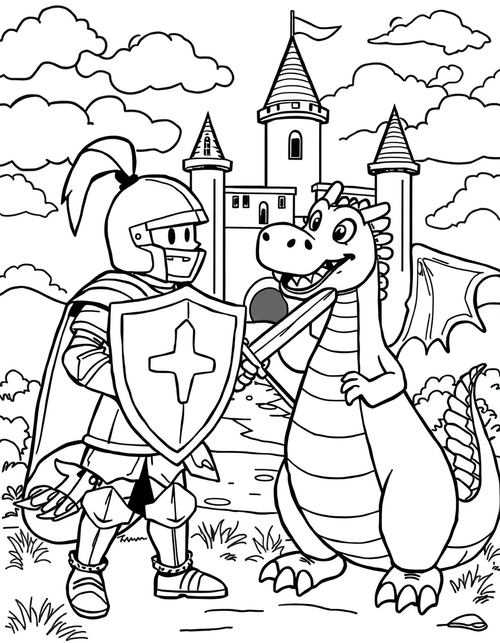
Knights are one of the few fantasy staples that were entirely real, and that is what makes them worth coloring carefully. Plate armor was engineered, heraldry followed rules, and a joust had a scoring system. These 15 knight coloring pages cover the whole life, from a squire practicing with a wooden sword to a full siege. Every design downloads as a free printable PDF sized for US Letter paper, 8.5 by 11 inches.
What Is in the Collection
Portrait and pose sheets are the simplest way in. Knight in Shining Armor on Horseback, Knight With Shield and Sword in Battle Stance, Young Girl Knight in Armor With a Shield and Young Squire Training With a Wooden Sword.
Action and adventure scenes are what children pick first. Knight Battling a Fearsome Dragon, Two Knights Jousting in a Tournament, Knight and Dragon and Knight Discovering a Hidden Treasure Chest.
Daily life gives the set its depth. Knight Polishing Armor at a Blacksmith Forge, Knight Camping in a Forest Clearing, Knight Kneeling Before a Queen and Knight Guarding a Castle Gate.
Three landscape pages close it out: Group of Knights Riding in Formation, Knight Crossing a Drawbridge at Dawn and Knight With a Banner on a Hilltop.
Who These Pages Are For
The simple sheets suit ages 5 to 9, with bold outlines and a clear single figure. The detailed sheets render individual armor plates, chainmail links and forge clutter, and suit ages 10 and up or an adult.
Teachers use knight pages during medieval history topics, which appear in most primary curricula, and the heraldry angle turns coloring into a design exercise: give a child the blank shield and let them invent a coat of arms following the real rules. The girl knight and squire pages matter here too, since they let every child in a class picture themselves in the topic. See also Castles, Dragons and Princesses.
Printing and Coloring Tips
Do not color armor flat gray. Steel is a mirror, so it picks up color from everything around it. Use a light gray base, add blue-gray in the shadows, warm ochre where the ground reflects up, and leave hard white streaks along the top edge of each plate. That combination is what makes metal look like metal.
Design the shield using real heraldic rules. Traditional heraldry uses metals, gold and silver, and colors, red, blue, green, black and purple, and the main rule is that you never put a color directly on another color or a metal on a metal. Gold on blue works. Red on green does not. It gives a child a genuine constraint to solve.
Print on 65 lb cardstock for the detailed sheets. Chainmail and forge scenes carry a very high line density, and heavier stock keeps those lines from filling in under marker.
More line art in this direction: Castles, Dragons and Wizards.
Frequently Asked Questions
How heavy was a suit of knight's armor?
A full suit of plate armor weighed roughly 45 to 55 pounds, which is comparable to a modern soldier's kit. Because that weight was distributed across the whole body rather than carried on the back, a trained knight could run, mount a horse unaided and get up from the ground in it. The idea that knights had to be craned onto their horses is a myth from Victorian fiction.
How did someone become a knight?
Through a long apprenticeship. A boy typically began as a page at around age 7, serving in a noble household and learning manners, riding and basic weapon handling. At about 14 he became a squire, attending a knight, caring for his armor and horse, and training seriously. Knighthood itself usually came at around 21, conferred in a ceremony called the accolade. The squire page shows the middle stage.
What were the rules of a joust?
Two riders charged along opposite sides of a barrier called the tilt, each aiming a blunted lance at the other's shield or helm. Points were scored for a clean strike, more for shattering the lance on the opponent, and most for unhorsing him. Striking a horse or hitting an opponent's back was penalized. It was a sporting contest, not a duel, and armor for it was heavier than battlefield armor.
How do you color knight armor realistically?
Treat it as a reflective surface rather than a solid color. Lay a light gray base, then add blue-gray into the recesses and where plates overlap, add a touch of warm brown or ochre near the bottom where the ground reflects upward, and leave a hard white highlight along the top edge of each curved plate. Hard-edged highlights are what separate polished steel from cloth.
Can I print these on A4 paper?
Yes. Every file is sized for US Letter. Choose "Fit to page" in your print dialog and the design scales to A4 without clipping.