Floral Pattern Coloring Pages
15 free printable pages, ready to download and print.
Create a Custom Coloring Page
Describe what you'd like and we'll generate it free, no account needed
Family-friendly only · 1 free per day


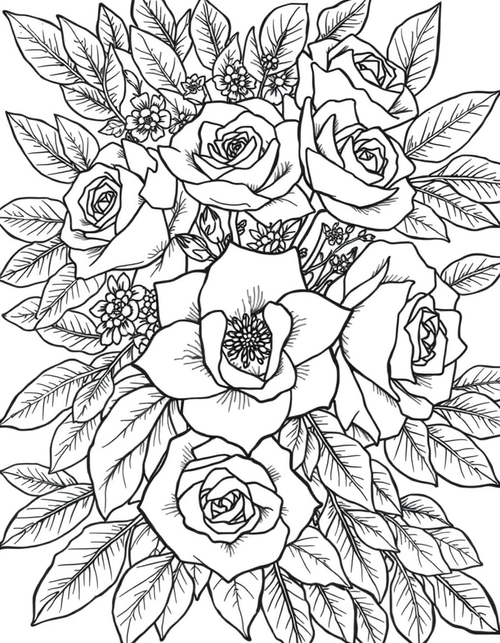
Flowers were the first thing anyone ever drew as a repeating pattern, and they are still the most reliable subject in adult coloring. There is no wrong color for a petal, the shapes nest inside each other naturally, and a botanical page gives you somewhere to put a whole pencil set. These 15 floral coloring pages run from single-stem studies to dense repeating patterns. Every design downloads as a free printable PDF sized for US Letter paper, 8.5 by 11 inches. Two of the heart coloring pages use this same botanical drawing, building the whole shape out of open flowers and leafy vines.
What Is in the Collection
Three formats sit side by side here, and they suit different moods.
Bouquets and arrangements give you a clear focal point. Intricate Rose Bouquet With Swirling Decorative Leaves, Peony Flowers With Ornate Vine Borders and Tulips in a Decorative Dutch Style Arrangement each center one group of blooms and frame it.
Repeating patterns have no focal point at all, which is what makes them meditative. Cherry Blossom Branch With Falling Petals Pattern, Wisteria Cascading in a Flowing Floral Pattern and Tropical Hibiscus and Palm Leaf Pattern fill the sheet edge to edge and can be picked up and put down mid-page without losing your place.
Radial and mandala style layouts split the difference. Geometric Floral Mandala With Dahlia Blooms, Lotus Flowers in a Symmetrical Repeating Pattern and Mixed Garden Flowers in a Circular Decorative Pattern reward a symmetrical color scheme, where each ring repeats one hue the whole way around.
Two scene pages round it out for anyone who wants a horizon: Sunflower Field With Decorative Scrollwork Border and Lavender Field With Honeybees.
Who These Pages Are For
This collection targets adults, but it is the most age-flexible set in the Adults category. The simple sheets have open petals a 9 year old can fill comfortably, so a parent and child can work matching pages at different detail levels.
Colorists using these therapeutically tend to prefer the repeating patterns, because there is no composition to plan and no point at which the page is objectively unfinished. Anyone practicing blending should start with the bouquets instead, where petals overlap and give you a reason to work a gradient.
Printing and Coloring Tips
Pick a three color scheme before you start a pattern page. Repeating designs collapse into visual noise when every bloom is a different color. Two flower colors plus one leaf green across the whole sheet looks deliberate.
Shade every petal from the base outward. Petals are darkest where they meet the center and lightest at the outer edge, and honoring that on even half the blooms makes a flat page look dimensional.
Print on 65 lb cardstock for markers or watercolor pencils. The dense pattern sheets carry a lot of ink per square inch, and 20 lb copy paper will buckle and bleed through to the sheet below.
More floral and botanical line art: Nature Flowers, Nature Gardens and Art Nouveau.
Frequently Asked Questions
What is the difference between the simple and detailed floral pages?
Simple sheets use thicker outlines and larger open petals, and most adults finish one in 20 to 30 minutes. Detailed sheets add interior linework such as petal veins, stamens and scrollwork borders, and run 60 to 90 minutes. Both cover the same flowers, so you can pick by how much time you have rather than by subject.
How do you blend colored pencils on flower petals?
Lay the lighter color over the whole petal first with light pressure, then add the darker color only near the base and press harder there. Go back over the boundary with the lighter pencil to soften it. Finish by burnishing the whole petal with a colorless blender or a white pencil, which crushes the pigment into the paper tooth and removes the streaks.
Which flowers are in this collection?
Roses, peonies, tulips, magnolias, orchids, sunflowers, lotus, dahlias, hibiscus, cherry blossom, wisteria, lavender and mixed wildflowers. The pattern sheets combine several of those on one page, so the botanical range is wider than the file count suggests.
Are floral coloring pages good for stress relief?
The repeating pattern sheets are the ones most people find calming, because they have no focal point and no correct starting place, so you can stop at any moment without leaving the page looking unfinished. Start with the cherry blossom or lavender pattern if that is what you are after, and save the bouquets for when you want a result.
Can I print these on A4 paper?
Yes. Every file is sized for US Letter. Choose "Fit to page" in your print dialog and the design scales down to A4 with the decorative borders intact.