Stained Glass Coloring Pages
Free printable stained glass coloring pages with thick leaded outlines and separate glass cells. Print any design as a PDF, no account needed.
Create a Custom Coloring Page
Describe what you'd like and we'll generate it free, no account needed
Family-friendly only · 1 free per day
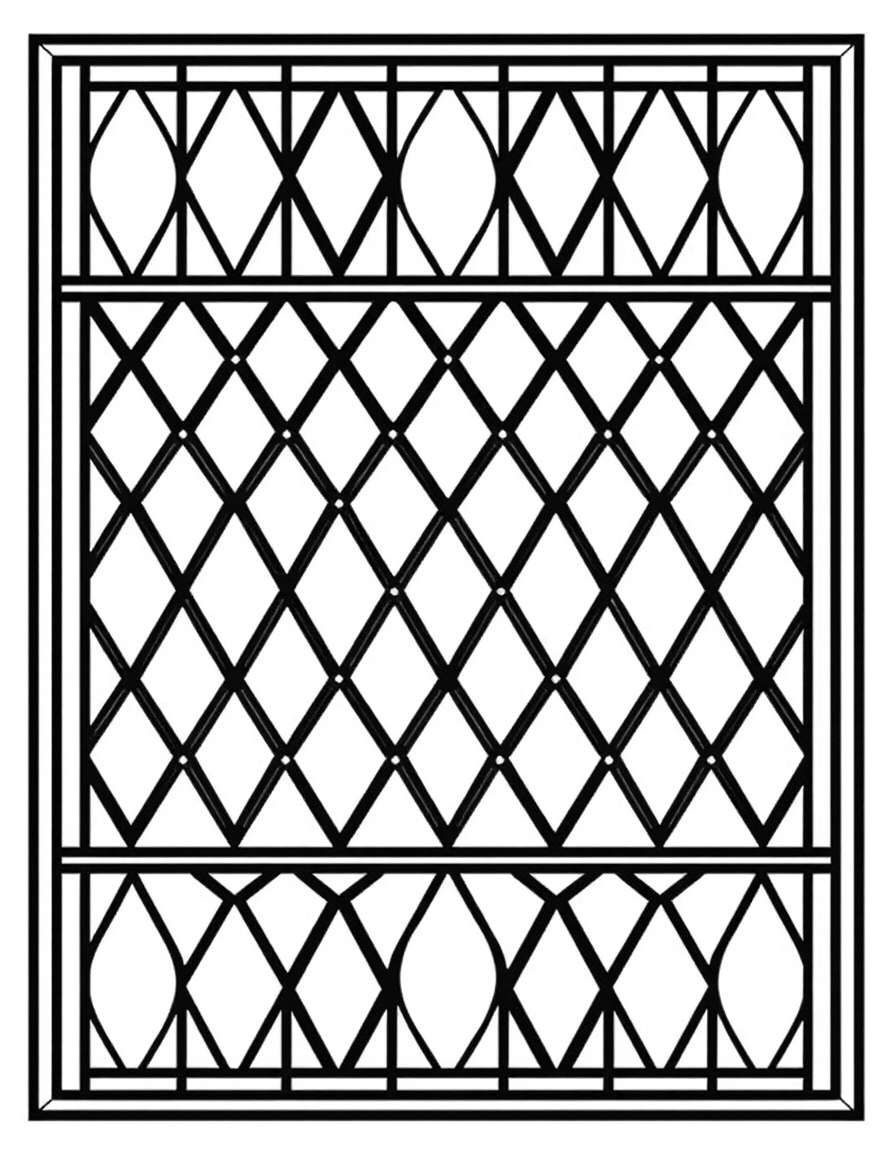
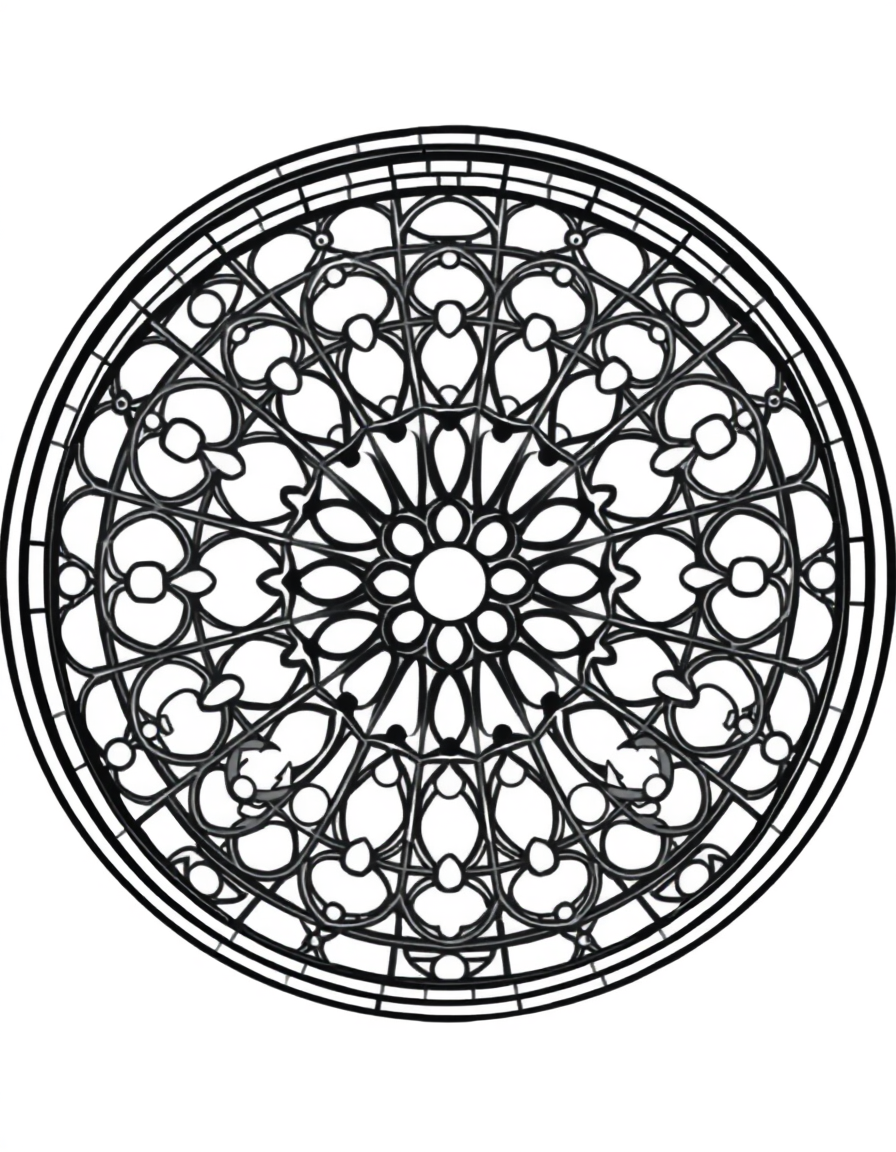
Stained glass earns its look from the lead, not the color. A real window is built from small pieces of colored glass held inside H-shaped lead channels called cames, and those dark seams are what your eye reads as stained glass before it registers a single hue. A coloring page only works in this style if it copies that structure, so every design here uses thick closed outlines with clearly separated cells rather than fine decorative linework. These 15 stained glass coloring pages download as free printable PDFs sized for US Letter paper, 8.5 by 11 inches.
What Is in the Collection
The set covers the four subjects that carry a leaded panel best.
Windows come first, because they are the form everyone pictures. A rose window splits a circle into radiating petal sections ringed by outer medallions, the shape Chartres and Notre-Dame made famous in the 13th century. A Gothic lancet window stacks narrow panels under a pointed arch and fills the top with stone tracery. Both give you a strong center and a rhythm of repeating cells to work around.
Flora is second. Tulip panels, a sunflower drawn as radiating petal cells, a water lily pond and a climbing rose vine in an arched frame. Glass studios favored these plants for the same reason the pages do: the shapes break into flat sections without losing what they are.
Birds and animals are third. A hummingbird at a trumpet flower, a peacock with a fanned tail, a sectioned butterfly wing and a dove above a bordered arch. Each one treats the creature as a set of glass pieces, which is exactly how Tiffany studios handled them.
Geometry and landscape close the set. A diamond lattice panel, a sunburst of concentric rings and a mountain sunset broken into horizontal bands. These are the easiest stained glass patterns to color if you want the look without committing to a two-hour page.
Every subject comes in a simple or a detailed treatment. Simple sheets hold 20 to 40 cells and finish in about 25 minutes. Detailed sheets push past 120 cells and take most adults 60 to 90 minutes.
How to Color a Page So It Reads Like Glass
Fill each cell with a single hue and stop. Real glass is dyed all the way through, so a piece is one color from edge to edge. Blending two colors inside one cell is the fastest way to lose the effect, and it is the mistake most people make on their first sheet.
Change the value between neighboring cells instead. Put a light amber next to a deep amber, then a mid amber beside that. The panel gains depth from the contrast across the leading, not from shading inside it.
Leave the outlines black. The thick lines are the lead, and lead is opaque. If you color over them the panel flattens into ordinary line art.
Work from a jewel palette. Cobalt, emerald, ruby, amber, violet and a warm gold cover almost every historical window you have seen. Six saturated colors read as glass. Twelve pastels read as a coloring book.
Keep one area much lighter than everything else. A pale cell or a small cluster of them tells the eye where the light is coming through, and the whole panel starts to look backlit.
Turn a Finished Page Into a Suncatcher
Print the design on vellum or tracing paper and color it with alcohol markers or glass paint. The ink sits on a translucent sheet, so light passes through it. Tape the finished sheet to a window and the colors project onto the sill the way real glass does.
Regular paper works too if you rub a thin coat of vegetable oil on the back once the coloring dries, then let it sit on newsprint overnight. The paper turns translucent and the color glows. Do this only with colored pencil or crayon, because oil lifts marker ink.
Printing and Paper
Print on 65 lb cardstock for markers or gel pens. The cells on these pages sit next to each other with no white gutter between them, so bleed-through on 20 lb copy paper shows up immediately and ruins the next cell.
These are stained glass coloring pages for adults and confident colorists aged 10 and up. The simple sheets suit younger children well, since the closed cells make staying inside the lines straightforward. Skip the detailed panels for that age group.
More pattern work for adults: Art Nouveau shares the leaded-panel look through Tiffany and Mucha, Geometric Mandalas offer the same symmetry and cell-filling rhythm, and Floral Patterns overlap with the rose window and botanical panels here.
Frequently Asked Questions
What makes a stained glass coloring page different from a regular coloring page?
The line weight and the cell structure. A standard coloring page uses thin outlines that describe a subject, and much of the sheet stays open white space. A stained glass page uses thick closed outlines that divide the whole panel into small separate compartments with nothing left unenclosed. That grid of cells is what makes the finished sheet look like leaded glass instead of like line art.
What is a rose window?
A rose window is the large circular window set above the entrance of a Gothic cathedral, built from glass sections that radiate out from a central medallion like petals. Chartres Cathedral and Notre-Dame de Paris hold the best known examples, both from the 13th century. On a coloring page the form gives you perfect radial symmetry, which means you can repeat one color sequence around the circle and the result stays balanced.
What colors did real stained glass windows use?
Medieval glassmakers were limited by chemistry, so the historical palette is narrow: cobalt blue from cobalt oxide, ruby red from gold chloride, emerald and bottle green from copper, amber and gold from sulfur and iron, and manganese purple. Pick five or six of those and the page will look like a window. Pastels and neutrals will not, because no medieval workshop could make them.
What pens or pencils work best on these pages?
Alcohol markers and gel pens give the flat saturated fill that reads as glass, and gel pens in metallic gold work well for the small border cells. Colored pencils work if you lay the color down evenly and resist shading. Watercolor also suits the style, since the transparency mimics light through glass, but print on 140 lb paper first.
Can I make my colored page glow like a real window?
Yes. Print on vellum or tracing paper, color with alcohol markers, and tape the sheet to a sunlit window. For a page already colored on regular paper, brush a light coat of vegetable oil on the back, blot it, and leave it to dry overnight on newsprint. The paper goes translucent and the color lights up.
Can I print these on A4 paper?
Yes. Every file is built for US Letter. Choose "Fit to page" in the print dialog and the panel scales to A4 with the outer border intact.