What Does the Color Pink Mean? Symbolism, History and How to Color It
November 12, 2026
Key Takeaways
- Pink is red mixed with white, and its symbolism follows that recipe: it keeps red's warmth but loses red's urgency, which is why pink reads as tenderness, care and comfort rather than passion or danger.
- Pink was a boys' color in the United States within living memory. A June 1918 trade article in Earnshaw's Infants' Department told retailers that "the generally accepted rule is pink for the boys, and blue for the girls."
- The most repeated claim in pink psychology failed to replicate. Baker-Miller pink calmed inmates in a Seattle naval jail in 1979, but the same shade raised the incident rate at the Santa Clara County jail in California.
- Which pink you get on paper is a pressure decision, not a shopping decision. One red pencil gives you gentle blush at light pressure and assertive hot pink once you layer and burnish it.
Who this is for: Colorists, parents and teachers who want to know what pink symbolizes and how to put that meaning onto a printed page.
Pink gets treated as the simplest color in the box: sweet, girlish, long settled. It is none of those things. Pink has switched genders once already, it carries the one famous color-psychology experiment that collapsed under retesting, and it is not a color that light can make on its own. This article covers what pink symbolizes and why, the history most pages get backwards, the study that failed, and how to put it onto a coloring page with pencils you already own.
Why Pink Reads as Gentle: It Is Red With the Heat Removed
Pink is the one everyday color name with no wavelength behind it. Every hue in a rainbow matches a single wavelength of light, but no wavelength looks pink. Pink happens only when red light arrives desaturated, mixed with white. That physical fact is also the best available explanation of its meaning.
Red at full strength is the color of alarm and appetite. It marks stop signs, warning labels and danger. Lower its saturation with white and the warmth survives while the urgency drains away. What is left is the pink cluster that recurs everywhere: affection rather than desire, nurture rather than drive, comfort rather than heat, gentleness and care. Romance belongs to pink, but passion stays with red.
The same logic explains pink's link to beginnings. Blossom, new skin and dawn light are all red softened by white, so pink attaches naturally to infancy, spring and renewal. Japan's cherry blossom is the strongest version, where pink stands for spring's arrival and its brevity at once. Since the early 1990s the pink ribbon has added solidarity and survival to the list.
Pink Was Named After a Flower, and It Used to Be a Boys' Color
The flower came first. English speakers called the frilled garden dianthus a "pink" before anyone used the word for a color, which only enters the record around 1733. The flower likely earned its name from its petal edges, because the verb to pink meant to cut a decorative zigzag. Pinking shears are named after the flower, not the reverse.
The gender story is recent, and it runs opposite to what people assume. In June 1918, the trade publication Earnshaw's Infants' Department advised retailers that "the generally accepted rule is pink for the boys, and blue for the girls," reasoning that pink was the stronger color and blue the daintier one. Nor was that settled: a 1927 Time survey found department stores split, with Marshall Field's and Filene's recommending pink for boys while Macy's and Wanamaker's advised the reverse.
Jo Paoletti of the University of Maryland, who wrote "Pink and Blue: Telling the Boys from the Girls in America," has documented that the pink-for-girls rule only hardened into convention around the 1940s. Pink's girlishness is roughly eighty years old, not ancient, and nothing about the color itself assigns it an audience.
The Pink Experiment That Did Not Replicate
Read anything about pink psychology and you will meet Baker-Miller pink, also called drunk tank pink. In 1979, researcher Alexander Schauss persuaded a naval correctional facility in Seattle to paint confinement cells a specific bubblegum pink, named after the two officers who approved it. The facility reported no aggressive incidents there for 156 days, and the result travelled fast: pink holding cells, pink locker rooms, pink wherever someone wanted calmer behavior.
The follow-ups did not cooperate. At the main jail in Santa Clara County, California, the same shade saw the incident rate rise rather than fall, peaking above the months before the repaint. Later work failed to confirm the claimed drops in heart rate and muscle strength, and the calming effect, where seen at all, wore off with exposure. Baker-Miller pink is a famous story rather than a reliable finding, and anything claiming pink measurably weakens people leans on a study that did not hold.
The softer claim survives it, though. Pink's associations with care and calm are real cultural meanings, learned and widely shared. They are simply not a physiological lever, and a page colored pink will not sedate anyone.
How to Put Pink's Meaning on a Coloring Page
Almost every article about pink answers with hex codes, one for blush and another for hot pink. A hex code is an instruction for a screen. A wax pencil cannot execute it, and no pencil set ships swatches labelled nurturing and bold. On paper, your control is pressure.
Start with what is in the tin. A standard 12-count Crayola colored pencil set holds red, red-orange, orange, yellow, yellow-green, green, sky blue, blue, purple, brown, black and white. There is no pink in it at all. You make pink by laying red down lightly and letting the white of the paper do the tinting, which is the red-plus-white recipe performed with paper instead of paint. Our guide to what colors make pink covers the mixing in full.
From one red pencil you can reach the whole emotional range:
- Gentle and nurturing: one light pass, barely weighting the pencil, so the paper shows through.
- Romantic mid pink: two or three light layers, each in a different direction.
- Assertive hot pink: four or more layers burnished together, or a single firm pass with a magenta.
Paper sets the ceiling. Standard printer paper is 20 lb and gives roughly three or four light layers before the tooth fills and the pencil skids instead of depositing pigment. For genuine hot pink on copy paper, press once with a magenta rather than building from red over six passes. Cardstock at 65 lb to 110 lb takes the extra layers, where blending technique matters more.
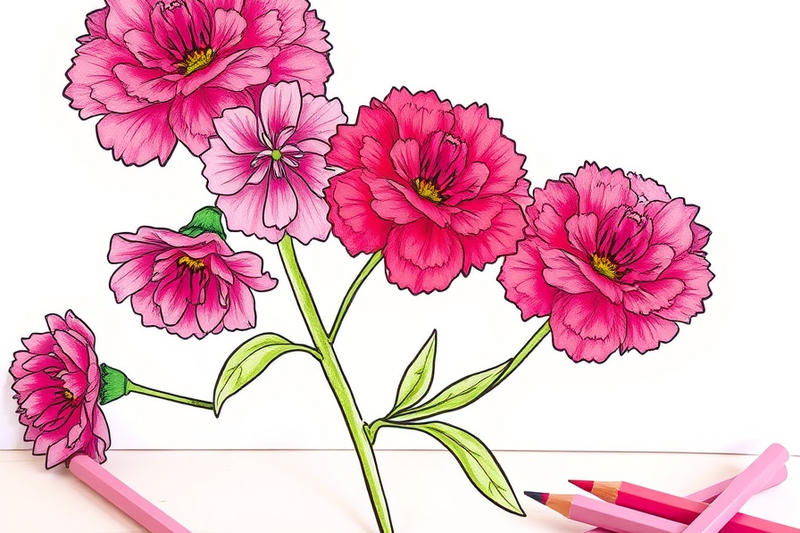
For practice, match the pink to the meaning. Flower pages suit the soft end and close the dianthus loop, heart pages sit in the affection range, unicorn pages are where hot pink earns its keep, and adult floral pages give you enough petals to try all three pressures side by side. Every page on ColoringDen is free, printable, and downloads as an instant PDF with no sign-up and no account.
Frequently Asked Questions
What does seeing the color pink mean spiritually?
In most Western spiritual traditions pink stands for unconditional love, compassion and emotional healing, and it is commonly associated with the heart chakra alongside green. Christian liturgy uses rose vestments on the third Sunday of Advent and the fourth Sunday of Lent, where the color signals joy interrupting a penitential season. No single doctrine fixes one meaning for pink.
Is pink a warm color?
Yes, pink is a warm color, because it is a tint of red and sits on the warm half of the color wheel. Pinks still split in practice. Coral and salmon pinks lean toward orange and read clearly warm, while fuchsia and magenta pinks lean toward blue and can look cool sitting next to them. Judge a pink against its neighbors, not alone.
What do pink roses mean?
Pink roses traditionally mean gratitude, admiration and gentle affection, which makes them the conventional choice for a thank-you or a friendship gift rather than a romantic declaration. Red roses carry romantic love instead. Depth shifts the message: pale pink roses suggest sweetness and sympathy, while deep pink roses read as appreciation and respect, following the same light-to-deep logic as the color itself.
What does the color hot pink symbolize?
Hot pink symbolizes boldness, confidence and playful rebellion, which is close to the opposite of soft pink's gentleness. Elsa Schiaparelli did not invent the shade, but she named it shocking pink in 1937 and built her fashion house and her perfume around it, which is where the daring association comes from. High saturation is what flips pink from calming to attention-seeking.
Bringing It Together
Pink means care, affection and comfort because of what it physically is: red with the heat taken out. The rest of its reputation is younger and shakier than it looks, from a gender rule that settled only in the 1940s to a prison experiment that never replicated. That frees you up, because pink is reserved for nobody and it is not doing anything to your nervous system.
The fastest way to understand its range is to color it. Print a sheet and run one red pencil from a whisper to a burnish across the same flower. Browse coloringden.com for thousands of pages that are free, printable, and download as instant PDFs with no sign-up required.