What Colors Make Pink? How to Mix Pink for Coloring Pages
September 24, 2026
Key Takeaways
- Red plus white makes pink, and white has to be your base: add red into white a touch at a time, because red pigment is far stronger and a mix that has gone too red cannot be walked back.
- Colored pencils, markers, and crayons carry no usable white pigment, so pink comes from light pressure with a red and letting the white paper supply the white.
- A cool, blue leaning red such as magenta or crimson mixes a clean bubblegum pink, while a warm, orange leaning red such as scarlet or cadmium red mixes coral and salmon instead.
- Pink is extra-spectral, meaning no single wavelength of light is pink. Screens build it by mixing red light with smaller amounts of green and blue, which is how the web color hotpink gets its value of #FF69B4.
Who this is for: Kids, parents, teachers, and adult colorists mixing pink with colored pencils, markers, or paint.
Pink shows up on more coloring pages than almost any other color: rose petals, unicorn manes, flamingo feathers, princess gowns, and every heart on every valentine. Yet most pencil sets ship with a red and no pink at all, and most paint sets hand you red and white with no instructions. This guide covers the two colors that make pink, how to get pink with no white at all, how to mix hot pink, blush, coral, and dusty rose on purpose, and the one mistake that turns a bright pink dull.
What Two Colors Make Pink
Red and white make pink. Pink is a tint of red, and a tint is any color lightened with white. That is why pink has no slot of its own on the standard color wheel. Green, orange, and purple come from mixing two colors. Pink comes from diluting one.
The part that trips people up is the order you mix in. Start with a puddle of white and add red one small touch at a time. Red pigment is much stronger than white, so a speck of red moves white a long way while a blob of white barely moves red. Start with red instead and you will burn through a tube of white and still land on a deep rose.
Pink also explains why red is not a printing primary. Home printers and commercial presses build every color from cyan, magenta, yellow, and black. Magenta, not red, is the subtractive primary, and magenta laid down lightly on white paper is exactly how a printer produces pink.
How to Make Pink Without White
Colored pencils, markers, crayons, and watercolors share a problem: white in those media is either missing from the set or too weak to lighten anything. A white colored pencil will not turn a red pencil pink. It smooths and burnishes the wax already on the paper, but it adds almost no tint of its own.
The answer is that your paper is the white. Pink comes from pressure, not from a second pigment.
- Hold the pencil at a low angle so the side of the tip meets the paper instead of the point.
- Lay down the lightest pass you can manage. You should barely see it.
- Build the color in three to five light layers rather than one heavy one. Each layer deepens the pink by a small, controllable step.
- Stop early. Adding another layer is easy and removing one is not.
Markers use a different lever. Make one quick pass and keep the tip moving, because a second pass over wet ink doubles the pigment and pushes pink straight through to red. Watercolor uses water as the lightener, so more water on the brush means a paler pink.
Shades of Pink: Hot Pink, Blush, Coral, and Dusty Rose
Every pink leans warm or cool, and the red you start from decides which one you get.
- Hot pink and bubblegum pink. Start from a cool, blue leaning red. Magenta, quinacridone rose, and alizarin crimson all qualify. Keep the mix saturated and only barely lightened.
- Baby pink and blush. Same cool red, far lighter. In pencil that is a single feather light layer. In paint it is a lot of white with a trace of red stirred in.
- Coral and salmon. Start from a warm, orange leaning red such as scarlet or cadmium red, then lighten it. A touch of yellow pushes it further toward coral.
- Dusty rose and mauve. Mix your pink first, then add the smallest possible touch of its complement, green, to knock the brightness down. One touch is enough, two is too many.
If your set already includes a pink pencil, treat it as a cool pink and modify it. A light pass of yellow gives coral. A light pass of red deepens it toward rose.
The Mistake That Turns Pink Muddy
Dull pink almost always comes from the wrong red, not from bad technique. Cadmium red and vermilion carry a strong orange bias. Lighten them and you get salmon, not bubblegum pink. Try to correct that back toward blue and you land in gray, because you are now mixing orange and blue, which are complements.
So check your red before you commit. Lay a heavy swatch on scrap paper and ask one question: does it lean toward orange or toward purple? An orange leaning red will never give you a clean cool pink no matter how much white you add. Swap the pencil instead of fighting it.
The second cause is sequence. Pink is light and transparent, so it covers nothing underneath it. Color your pink areas before you lay down the darks around them.
Pages to Practice Pink On
Pink rewards practice on large, simple shapes where a gradient has room to develop.
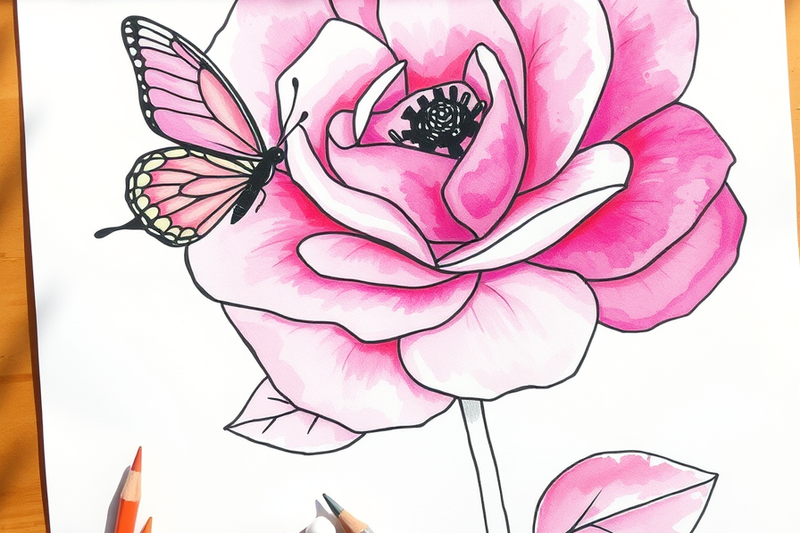
- Flower coloring pages give you petals that shade from pale at the base to saturated at the edge, the fastest way to learn pressure control.
- Unicorn pages are the classic hot pink subject, and a mane is a good place to run three pinks side by side.
- Butterfly pages have symmetrical wings, so you can mix a shade on one wing and try to match it on the other.
- Princess pages set pink against skin tones and fabric, where warm and cool pinks read most clearly.
- Valentine''s Day pages are almost entirely pink and red, so they test whether your two reds are actually different.
Every page linked above downloads free as a printable PDF with no sign-up and no account.
Frequently Asked Questions
What color do pink and blue make?
Pink and blue make lavender or light purple. Pink is red that has already been lightened with white, and red plus blue makes purple, so the white carries through and gives you a pale purple rather than a deep one. If you want a richer purple, mix blue with an unlightened red, or better, with magenta.
Do red and green make pink?
No. Red and green sit opposite each other on the color wheel, and mixing them as pigment produces brown, olive, or gray depending on the ratio. The confusion comes from light rather than paint. On a screen, red and green light combine into yellow, and screen pink is red light plus smaller amounts of green and blue.
What color do pink and green make?
Pink and green make a soft gray brown, often called a neutral. Green cancels the red inside the pink and leaves a dull tone behind. That reaction is useful on purpose: one very small touch of green turns a loud pink into dusty rose, and it is the standard way to mix a muted vintage pink without buying another pencil.
What color do pink and yellow make?
Pink and yellow make peach, and more yellow takes it to coral. Peach is a useful base for light skin tones, so this mix earns its place on a portrait or a princess page. Both colors are pale, so the result stays light. Build it in two or three layers instead of trying to reach coral in one pass.
How do you make pink frosting or pink food coloring?
Add red food coloring to white frosting one drop at a time and stir it in completely before you judge the shade, because the color keeps deepening as it sits. Gel coloring is much stronger than liquid, so start with a toothpick tip of gel per cup of frosting. For a cooler pink, choose a red labeled rose or fuchsia.
Start With One Pink Page
Pink is the easiest color to mix and the easiest to overdo. Keep white as your base when you paint, keep your pressure light when you use pencils, and pick a red that already leans the direction you want to go. Three light layers will teach you more about pink than any color chart.
ColoringDen is free, printable, and instant, with every page downloading as a PDF with no sign-up and no account. Print a sheet of flowers or hearts and have a pink swatch test running in under a minute.