What Does the Color Green Mean? Symbolism, Psychology and How to Color It
November 13, 2026
Key Takeaways
- Green means growth, renewal and balance because it is the color of chlorophyll, the pigment plants use to capture sunlight, and because it sits exactly between blue and yellow on the color wheel.
- Your eye sees green better than any other color. Daylight vision peaks at a wavelength of about 555 nanometers, which is a yellow-green, so green genuinely is the easiest hue for human eyes to judge.
- Green also carries a negative set of meanings that came from medicine rather than botany: jealousy, nausea and inexperience. Shakespeare's Iago called jealousy "the green-eyed monster" in Othello around 1604, and the phrase outlived the theory behind it.
- Green was not originally Ireland's color. St Patrick was associated with a sky blue, and green only took over after the Irish Rebellion of 1798 turned the shamrock into a nationalist emblem.
Who this is for: Colorists, parents and teachers who want to know what green symbolizes and how to get real greens onto a printed page.
Green is the color people call restful and then borrow for a warning about envy. It is the color of money and of nausea, of permission to go and of being too new to trust. That contradiction comes from two separate sources, one botanical and one medieval, and both are still live in English. This article covers where green's growth meanings come from, why the opposite set stuck for four centuries, what green means across cultures, and how to reach the full range of greens with the pencils in an ordinary tin.
Why Green Means Growth: Chlorophyll and the Color Your Eye Sees Best
Green's positive meanings trace back to one fact about plants. Chlorophyll absorbs red and blue light and reflects the middle of the spectrum straight back at you, so nearly every living leaf on Earth looks green. Wherever plants grow, green is the visible evidence. Life, renewal, fertility, spring and health belong to green for the plainest reason available: that is what the color reports.
The second reason sits in your eye. Under daylight conditions, human brightness sensitivity peaks at a wavelength of roughly 555 nanometers, which is a yellow-green. The same amount of light energy looks brighter delivered as green than as red or blue, and your eye judges green detail more accurately than any other hue. That is why high-visibility safety gear tends toward yellow-green, why night vision displays are green, and why "easy on the eyes" is doing real physical work as a phrase.
Position on the color wheel supplies the third meaning. Green sits between blue and yellow, so it inherits blue's calm and yellow's warmth without reaching either extreme, and balance, harmony and stability all come from that middle position. Red, its complement, sits opposite and signals the reverse: stop, danger, heat.
Green's Other Half: Envy, Sickness and Being New
The negative meanings arrived through medicine. Renaissance physicians explained temperament through the four humors, and an excess of bile was believed to tinge the complexion green and sour the disposition into bitterness and suspicion. Jealousy was a bilious condition, so jealousy was a green condition.
Shakespeare fixed that idea in the language. He used "green-eyed jealousy" in The Merchant of Venice first, then wrote the version everyone remembers into Othello, where Iago warns, "Oh, beware, my lord, of jealousy! It is the green-eyed monster which doth mock the meat it feeds on." The humoral theory collapsed centuries ago. The line did not, which is why English speakers still say green with envy.
Sickness works more directly. Skin can take on a faintly green cast when someone is nauseated, which is where "green around the gills" comes from. Inexperience loops back to plants. Unripe fruit is green, unseasoned timber is called green wood, and a greenhorn originally meant a young animal whose horns were still new before the word transferred to raw recruits.
A green dragon reads as mossy and ancient or as poisonous and sick, and what decides it is whether you push the green toward yellow or toward gray.
What Green Means Across Cultures and Industries
In Islam, green is the color of paradise: the Quran describes its inhabitants clothed in green silk, and green dominates the flags of Saudi Arabia, Pakistan and Bangladesh.
Ireland is the case most people get backwards, because blue came first. Henry VIII's 1541 coat of arms set a gold harp on a dark blue field, and when George III founded the Order of St Patrick in the 1780s its official color was sky blue, still known as St Patrick's blue. Green replaced it politically rather than scenically: during the Irish Rebellion of 1798 the shamrock became a nationalist symbol, and "the wearing of the green" turned into an act of defiance rather than a tribute to the landscape.
Finance and traffic both read green as permission and gain. United States banknotes have been green-backed since the Civil War era, a green light means go, and American market screens show gains in green. That convention is not universal: in China, Japan and South Korea, rising prices are shown in red and falling prices in green, the exact reverse.
The environmental sense is the youngest of all, dating only to the 1970s, when groups like Greenpeace, founded in 1971, attached the color of living plants to the business of protecting them.
How to Get Green's Meaning Onto a Coloring Page
Most articles about color meaning answer with hex codes. A hex code is an instruction for a screen, and a wax pencil cannot execute it.
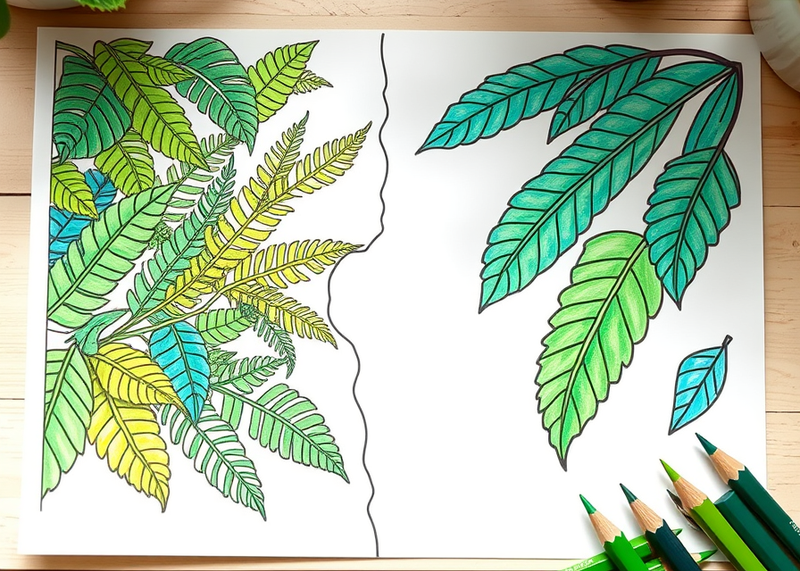
Start with what is in the tin. A standard 12-count Crayola colored pencil set holds red, red-orange, orange, yellow, yellow-green, green, sky blue, blue, purple, brown, black and white. That is two greens for the whole living world, so the range comes from mixing, not from buying. Yellow laid over green pushes toward new growth and spring. Blue laid over green pushes toward depth, shade and stillness. A whisper of red, green's complement, drains the life out of it and gives you the sickly, swampy green that a bog or a villain needs. Our guide to what colors make green covers the mixing in detail.
Paper sets the ceiling. Standard printer paper is 20 lb and accepts roughly three or four light layers before the tooth fills and the pencil skids instead of depositing pigment. Cardstock runs 65 lb to 110 lb and takes considerably more. So for a deep forest green on copy paper, lay one light pass of blue down first and bring green over the top, rather than burnishing green six times. Our guide to blending colored pencils covers the layering order.
Then match the subject to the meaning you want to practice. Forest pages give you enough foliage to run yellow-green through blue-green across one sheet, garden pages set green against its complementary reds, frog pages are where the sickly end of green earns its keep, and Earth Day pages carry the modern environmental meaning directly. Every page linked above is free, printable, and downloads as an instant PDF with no sign-up and no account.
Frequently Asked Questions
Is green a warm or cool color?
Green is a cool color, because it sits on the cool half of the color wheel next to blue. Individual greens still split. Yellow-greens such as chartreuse and olive lean toward yellow and read warm beside a true green, while blue-greens such as teal and viridian read distinctly cold. Judge any green against the colors beside it rather than on its own.
What does it mean if green is your favorite color?
Conventionally, a preference for green is described as marking someone practical, balanced and drawn to the outdoors. Be careful with that: no validated psychological research links a favorite color to specific personality traits, and color-personality descriptions are written broadly enough that most people recognize themselves. Liking green is good evidence that you like green.
What does dark green mean compared with light green?
Dark green means wealth, stability and tradition, which is why banks, law firms and heritage brands reach for it. Emerald green adds luxury to that list. Light greens reverse the emphasis toward newness and calm, so mint and sage read as fresh, clean and gentle. Saturation drives the difference more than hue does: a deep saturated green feels established, a pale one feels recent.
What does green mean spiritually?
Green is the color of the heart chakra, the fourth of the seven chakras, where it stands for love, compassion and healing. Christian liturgy assigns green vestments to Ordinary Time, the longest stretch of the church year, and the meaning there is steady growth rather than celebration. The "green pastures" of Psalm 23 carry the same sense of provision and rest.
Bringing It Together
Green means growth because that is what chlorophyll looks like, and it means balance because it sits halfway between blue and yellow. The envy and sickness meanings came from an abandoned medical theory and a playwright with one unforgettable line. Both sets survive, so green is the rare color you can steer in opposite directions depending on whether you push it toward yellow or toward gray.
The quickest way to feel that range is to color it. Print one leafy sheet and run a single green pencil from yellow-shifted new growth on the top leaves to blue-shifted shade underneath. Browse coloringden.com for thousands of pages that are free, printable, and download as instant PDFs with no sign-up required.