What Colors Make Orange? How to Mix Orange for Coloring Pages
September 18, 2026
Key Takeaways
- Red and yellow make orange, and roughly two parts yellow to one part red gives the balanced tangerine most people picture when they say orange.
- The brightest orange comes from a warm red and a warm yellow, such as cadmium red light with cadmium yellow, because both pigments already lean toward orange. A cool red like alizarin crimson carries a hidden blue bias that dulls the mix.
- Blue sits directly opposite orange on the artists' color wheel, so one small touch of blue turns bright orange into burnt orange, terracotta, or brown.
- Screens and printers build orange without any red pigment at all. A screen mixes red light with roughly two thirds as much green light, which is why the web color named orange is rgb 255, 165, 0, and a home printer mixes magenta ink with yellow ink.
Who this is for: Kids, parents, and adult colorists mixing orange for foxes, pumpkins, tigers, and autumn leaves.
Orange looks like the easy one. Two colors, no tricks, and almost every pencil set already holds both of them. Then you press down and get rust, or salmon, or a flat brownish thing that looks nothing like a pumpkin. The recipe is fine. The two colors you started from decided the result. This guide covers the base mix and its ratio, the pigment bias that makes orange glow or go gray, the shades behind a red fox and a tiger stripe, and why colored pencils need you to layer orange instead of stir it.
Red and Yellow Make Orange
Red and yellow make orange. Orange is a secondary color in the red, yellow, and blue model that paint sets, colored pencil ranges, and classroom color wheels are built on. It sits between red and yellow on that wheel, which tells you something useful: your mix is a slider, not a single point.
Start at about two parts yellow to one part red. Red pigment is far stronger than yellow, so very little red swings the whole mix. Working the other way around, dropping yellow into a pool of red, lands on a dark brick color long before it reaches orange.
Once you have that base, move along the slider on purpose:
- More yellow gives amber and golden yellow-orange, good for candlelight, sunflower centers, and the light side of a leaf.
- Even parts give a true, balanced orange, the pumpkin color.
- More red gives red-orange and vermilion, the color of a red fox coat and a maple leaf in late October.
Pick a Warm Red and a Warm Yellow
Every red and every yellow leans slightly toward a neighbor on the color wheel, and that lean is called color bias. It is what separates a glowing orange from a dull one.
Cadmium red light and cadmium yellow both lean toward orange. Mix those two and you get the brightest orange your set can produce, because neither parent is dragging the mix anywhere else. Alizarin crimson and quinacridone magenta lean the other way, toward violet, and lemon yellow leans toward green. All three carry a trace of blue.
Blue is orange's complement, so any blue hiding inside either parent works against you the moment the two meet on the paper. A cool crimson plus a lemon yellow still makes something orange-ish, but it lands gray and tired next to the warm pairing. Inexpensive 12 and 24 pencil sets usually ship one mid red and one mid yellow with a slight warm lean, which is genuinely fine. Test the pair on a scrap corner first.
The Orange Shades Real Pages Ask For
Generic orange is rarely what a page needs. These are the mixes worth memorizing:
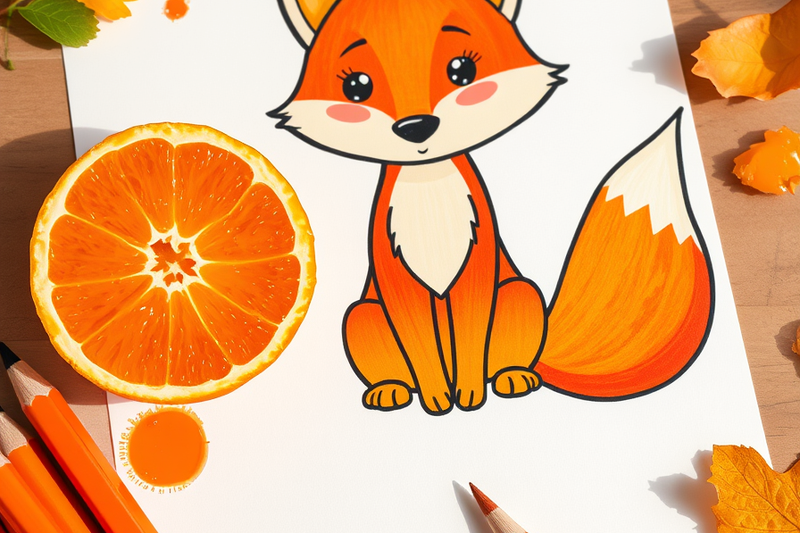
- Red fox: a red-leaning orange, roughly even parts red and yellow, deepened along the back with a whisper of brown. Leave the chest, muzzle, and tail tip as bare paper rather than coloring them white. Practice on the fox coloring pages.
- Pumpkin: a true balanced orange across the body, with the ribs pushed toward red-orange and a strip of untouched paper left as the highlight. The pumpkin collection is full of them.
- Tiger: a warm mid orange, fading to pale yellow-orange along the belly and inside the ears, with black stripes laid down last. See the tiger coloring pages.
- Autumn leaf: run the whole slider across a single leaf. Yellow-orange at the stem, true orange through the middle, red-orange at the tips. The fall collection is built for this.
Every page in those collections is free and printable, downloads instantly as a PDF, and needs no sign-up and no account. That matters for color mixing specifically, because you can print the same fox twice and test two different orange recipes side by side instead of committing to your first guess.
Layer Orange, Do Not Stir It
Colored pencils do not mix the way paint does. The pigment sits suspended in a binder, wax in Prismacolor Premier and oil in Faber-Castell Polychromos, and each layer stays slightly transparent over the one beneath it. Your eye does the mixing, not the pencil.
That changes the order of operations. Lay the yellow down first, across the whole shape, with light pressure and a sharp point. Then glaze the red over the top in three to five light passes, building toward the strength you want. Yellow is the weakest pigment in the box and it will never cover red that is already on the paper, so putting red down first locks you out of the lighter half of the range.
Light layers also hold more total pigment than one heavy pass. Pressing hard burnishes the paper flat, and once that happens the surface stops accepting color.
Burnt Orange, Terracotta, and Peach
The interesting oranges all come from the base mix plus one small adjustment:
- Burnt orange: add a tiny touch of blue. Because blue is the complement, it neutralizes the mix rather than tinting it, and the orange drops into a deeper, smokier range.
- Terracotta: the same touch of blue, with extra red in the base.
- Peach: the same orange, applied with very light pressure on white paper. Reaching for a white pencil usually just smears what is already there.
- Coral: orange plus a pink, which pulls it toward the warm side of the flower range you will find across the flower pages.
- Jack-o-lantern glow: orange with a thin red-orange glaze over it, kept darkest at the edges, which reads well across the Halloween pages.
Frequently Asked Questions
Can red and green make orange?
No. Red and green make a muddy brown or a dull olive. Green is itself a mix of blue and yellow, so the blue riding inside it lands in your mix and cancels the brightness, since blue is orange's complement. The yellow inside the green is the only part helping you, and there is not enough of it. Use a straight yellow instead.
Can blue and yellow make orange?
No. Blue and yellow make green, and there is no path to orange that skips red entirely. Orange sits between red and yellow on the color wheel, so one of its two parents has to be on the red side. If your set has no usable red, a magenta or hot pink will get you there, but blue never will.
What color do blue and orange make?
Blue and orange make brown, or a soft neutral gray when the two are close to balanced. They are complements, so mixing them cancels both rather than creating a new hue. This is useful rather than disappointing. A light blue glaze over an orange shape is the cleanest way to shade it without muddying the color.
How do you make orange without red?
Use magenta and yellow. That is exactly how a home printer does it, because CMYK printing uses magenta as a primary instead of red, and it produces orange from magenta and yellow ink alone. A hot pink colored pencil layered under yellow follows the same logic and gets close. With neither a red nor a magenta in the set, orange is out of reach.
What does orange and yellow make?
Orange and yellow make amber, a lighter golden yellow-orange. It is the most useful variation on this list because it reads as light. Use it for the belly and inner ears of a tiger, the lit face of a pumpkin, the center of a sunflower, and the band just above the horizon in a sunset, where a full-strength orange would look heavy.
Start Mixing
Orange rewards restraint. Two parts yellow, one part red, both of them warm, layered rather than stirred, and one small touch of blue when you want autumn instead of a traffic cone.
The fastest way to learn it is to color the same shape twice with two recipes and compare. Browse coloringden.com and print a fox, a pumpkin, or a tiger. Every page is free, prints clean, and downloads as an instant PDF with no sign-up.