What Colors Make Magenta? How to Get True Magenta on Coloring Pages
October 16, 2026
Key Takeaways
- No two pigments mix into true magenta, because magenta is a primary ink in the CMYK printing system rather than a blend of other colors.
- The closest mixable magenta starts from a cool blue-leaning pink, ideally the pigment quinacridone magenta listed as PR122, with one light pass of violet over it.
- Magenta on a screen and magenta on paper work in opposite directions: a display builds it from full red plus full blue with the green channel off, at hex #FF00FF, while paper needs one dedicated ink.
- Magenta layered under yellow makes red, and magenta layered under cyan makes blue, so one magenta pencil widens the range of a small set more than any other single color.
Who this is for: Colorists working with a basic pencil, marker, or paint set who want a vivid magenta on flowers, unicorns, and mandalas.
Reach for red, press blue over it, and you get purple every time. Magenta never shows up. That is not a flaw in your technique, and a more expensive set will not fix it. Magenta belongs to a small group of colors that pigment mixing cannot reach from ordinary starting points, which is exactly why every printer keeps a dedicated magenta cartridge loaded. This guide covers what magenta actually is, the closest mix you can build with pencils, markers, paint, or crayons, and how to layer it on a printed page so it stays vivid instead of drifting chalky.
Why You Cannot Mix True Magenta
Magenta is one of the four process inks in CMYK printing, sitting alongside cyan, yellow, and black. Printers treat it as a starting point rather than a result. The inkjet on your desk loads a magenta cartridge for one reason: nothing else in the tray can produce that hue.
Pigment mixing is subtractive. Every pigment you add removes more wavelengths from the light bouncing back off the paper, so mixes always trend darker and duller than the colors that went into them. Red pigment absorbs blue and green light. Blue pigment absorbs red and green light. Stack the two and you absorb nearly everything, which lands you in dark violet and dull plum instead of a glowing pink-red.
Light runs the other way. Magenta ink absorbs green and reflects both red and blue, and a screen builds the same sensation by firing its red and blue pixels at full strength with green switched off. That value is hex #FF00FF, and web browsers list it under two different names, magenta and fuchsia, both pointing at the same color. This is why magenta looks electric on a phone and stubbornly calmer on paper.
The Closest Magenta You Can Mix With Colored Pencils
Start from pink, never from red. A cool, blue-leaning pink already carries most of the hue you need, while a warm red drags orange into the mix and fights you the whole way.
The working recipe runs three steps:
- Lay three to five light layers of the brightest cool pink in your set. Hold the pencil at a low angle so the side of the core touches the paper, and keep your pressure light enough that the paper texture still shows through after the first pass. Light layers trap more pigment than one heavy push, because a burnished surface stops accepting new wax.
- Add a single light pass of violet or purple across the whole area. One pass. Two passes tips the color into purple and you cannot pull it back.
- Reassert the pink on top. This buries the violet, keeps the surface reading pink-red rather than purple, and smooths the two layers into one hue.
Pigment matters more than brand name. Quinacridone magenta, printed on art supply labels as PR122, is the single pigment closest to process magenta, and it appears in pencils, paints, and markers across many manufacturers. When a barrel lists its pigment code, that code tells you far more than the marketing name on the label. Binder matters too: Prismacolor Premier pencils use a wax binder that blends under light pressure, while Faber-Castell Polychromos pencils use an oil binder that holds a crisper edge and needs more layers before the colors melt together.
Mixing Magenta in Paint, Marker, and Crayon
Watercolor gives you the strongest result of the three. Thin washes stay transparent, so a cool rose wash with a whisper of violet dropped in while the paper is still damp keeps its glow instead of going flat.
Markers do not mix the way paint does. Two marker colors laid over each other produce a third color instantly and permanently. Work pink first, touch violet only into the shadow side of a shape, then run a colorless blender from the pink toward the violet to soften the seam.
Crayons sit on the paper as a wax film rather than soaking in. Layer the pink heavily, add violet only where the shape turns away from the light, then buff the whole area with a white crayon. That buffing step pushes wax into the paper tooth and lifts the apparent brightness.
How to Layer Magenta So It Stays Bright
Paper weight decides how much pigment the page can hold. Standard printer paper is 20 lb, while cardstock runs 65 lb to 110 lb, and the heavier sheet accepts several more layers before the surface closes up and refuses more color. If a magenta keeps going chalky on you, the paper gave out before the pencil did.
Protect the brightest areas by leaving them alone. Magenta reads vivid mostly by contrast, so plan one or two spots on each shape where you put down almost nothing and let the white paper carry the highlight. Shade the opposite side with violet or a deep crimson rather than grey, because grey pulls the saturation straight out and no amount of pink on top brings it back.
Avoid tracing the shape with black at the end. A black outline against magenta flattens the color and makes the whole area read dull. A deep violet outline holds the drawing together and keeps the hue alive.
Pages to Practice Magenta On
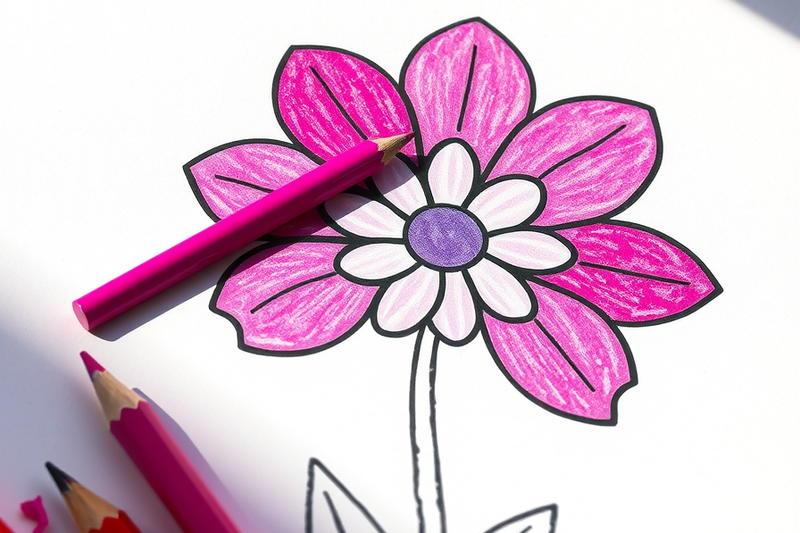
Magenta earns its keep on subjects that are allowed to be loud. Bougainvillea and orchids on the flower coloring pages take magenta straight out of the pencil with no apology. Unicorn manes on the unicorn coloring pages are a good place to run magenta into violet and watch the transition. For a controlled drill, the repeated shapes on the butterfly mandala pages let you test the three-step recipe at four pressures side by side on one sheet. Adults who want longer sessions can work the detailed floral coloring pages, and kids can keep it simple on the heart coloring pages.
Every page linked above downloads free as a printable PDF with no sign-up and no account, so you can print the same sheet three times and treat the first two as practice.
Frequently Asked Questions
Is magenta pink or purple?
Magenta is neither, although it sits between them. Purple contains more blue than red, and pink is simply red that has been lightened toward white. Magenta holds red and blue at equal strength with no green at all, which is the #FF00FF value a screen produces. That balance is what makes magenta read hotter than purple and far more saturated than pink.
Is magenta a real color?
Yes, although it has no wavelength of its own. Every spectral color, from red at roughly 700 nanometers to violet near 400, corresponds to one wavelength of light. Magenta corresponds to none. Your eye reports red and blue cone activity with nothing from the green cones, and your visual system resolves that combination as magenta. Colors built this way are called extra-spectral, and magenta is the best known of them.
What colors go with magenta?
Green is magenta''s direct complement, so lime, moss, and deep forest green all create the strongest contrast next to it. Teal and turquoise sit slightly off the complement and feel less jarring on a full page. Warm gold and soft cream give magenta room to dominate, and a warm grey shadow keeps a magenta subject from competing with everything around it.
What does magenta and yellow make?
Magenta and yellow make red. Commercial printing relies on this every day, since there is no red ink in a CMYK press and red gets built by overprinting magenta with yellow. On a coloring page, lay magenta down first and add yellow on top in light passes. Stopping early gives a rose red, and pushing the yellow further moves you toward a warm orange-red.
Start Coloring
Magenta is the one hue your set either owns or it does not, so build the closest version you can from a cool pink plus a single pass of violet, then protect it with light layers and clean highlights. Print one page, run the recipe at three pressures, and keep that sheet as your reference.
Browse coloringden.com to find a page worth the effort. Every sheet is free, printable, and downloads instantly as a PDF with no account required.