What Colors Make Red? How to Mix Red for Coloring Pages
September 21, 2026
Key Takeaways
- No two paints or colored pencils mix into a true red, because red is one of the three primaries in the red, yellow, and blue model that art supplies are built on. The practical answer is to start with a red you own and steer it.
- Magenta and yellow make red. That is how a home inkjet printer produces every red on the page, because CMYK printing uses cyan, magenta, and yellow as its primaries instead of red, yellow, and blue.
- Add a little yellow to push red toward scarlet, and add the smallest touch of blue to pull it toward crimson. Red pigment is strong, so use roughly one part of the second color to eight parts red and build from there.
- Red mixed with green makes brown or a near neutral gray, because the two sit opposite each other on the artists' color wheel. That is why red goes muddy the moment green creeps in, and it is also the cleanest way to shade red without black.
Who this is for: Kids, parents, and adult colorists mixing reds for hearts, roses, fire trucks, and dragons.
Ask which two colors make red and most answers either dodge the question or hand you a recipe that produces a dull brick. The truth is more useful than either. Red behaves differently from orange, green, and purple, and once you know why, every red problem on a coloring page gets easier. This guide covers why paint cannot reach red from scratch, the one pair that gets close, how to move a red you own toward scarlet, crimson, or burgundy, and how to lay it down so it looks solid instead of streaky.
Red Is a Primary Color, So Nothing Mixes Into It
Red is a primary color in the red, yellow, and blue system that paint sets, colored pencil ranges, and classroom color wheels use. Primary means it is a starting point. Orange comes from red and yellow, green from yellow and blue, purple from red and blue, but red itself has no parents inside that system.
There is a physical reason, not just a naming convention. Paint and pencil pigments mix subtractively: each pigment absorbs part of the light hitting the paper and reflects the rest. Combine two and the mixture absorbs everything either one absorbed, so it reflects less light than either color alone. Every mix is duller than its parents, and you cannot reach a clean, saturated red by stacking up duller ingredients. That is what people find when they try orange and pink, or purple and orange, and end up with mud.
So the honest answer has two halves. Inside a normal pencil set, nothing makes red. Outside that set, one pair comes close.
Magenta and Yellow Make Red
Magenta and yellow make red. This is not a workaround, it is how printed red works. Home and office printers load cyan, magenta, yellow, and black ink, and that CMYK system treats magenta, not red, as a primary. Every red in a photo you print is magenta ink overlapping yellow ink. Nothing in the printer is red.
You can copy that on paper. Lay down a magenta or hot pink, then layer yellow on top. A magenta with a blue lean, such as a quinacridone magenta pigment labeled PR122, works better than a pale bubblegum pink, because the pink is already diluted with white and mixes toward salmon. Go roughly even on the two, then add yellow until the pink stops showing.
Expect a bright, slightly orange-leaning red rather than a deep crimson. It looks great on a fire truck, a strawberry, or a cartoon heart, and less convincing on velvet. For that depth you need a red in the box.
Screens work the opposite way. A monitor adds colored light instead of subtracting it, and red is one of its three primaries, which is why pure red on the web is rgb 255, 0, 0.
How to Mix Scarlet, Crimson, and Burgundy From One Red
Most coloring problems are not about making red. They are about making the right red. Start from the red you own and treat it as the middle of a slider.
- Scarlet and vermilion: add a little yellow or orange. This is the warm, bright red of a fire engine, a ladybug shell, and a Santa suit. Start at about one part yellow to eight parts red, because yellow lifts a red quickly.
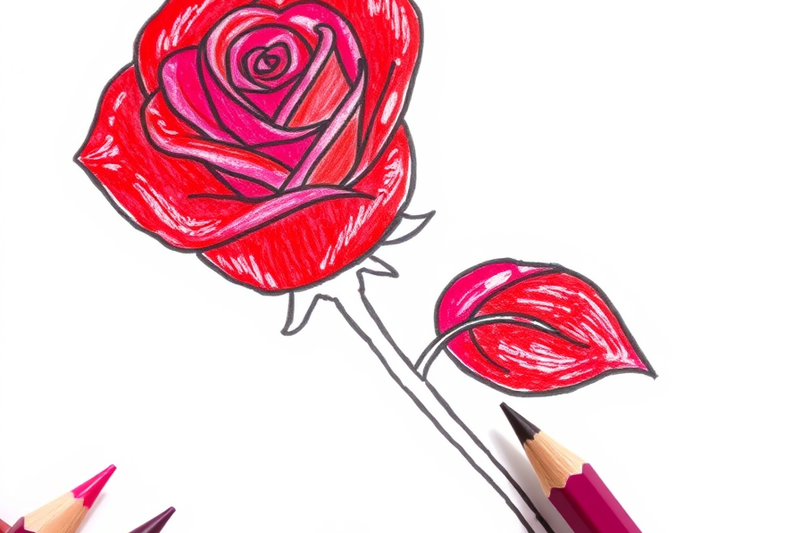
- Crimson and cherry: add the smallest touch of blue or magenta. This cool red suits roses, wine, cherries, and lipstick. Blue is overwhelmingly strong here, so the tip of a pencil or the edge of a brush is enough. Too much and you land in purple.
- Maroon and burgundy: add a touch of green, or blue plus a whisper of brown. Green is the complement of red, so it darkens without flattening the way black does. Black kills the glow of a red almost immediately.
- Shadows: layer dark blue or deep violet over the red rather than gray. Shadows on a red object stay red, they just get cooler and deeper.
Your starting red matters as much as what you add. Cadmium red, a warm red sold under pigment code PR108, already leans orange, so it makes brilliant scarlets and struggles to reach a clean crimson. Alizarin crimson leans blue and does the reverse. If your set holds two reds, stroke both on scrap paper to see which way each one leans.
Making Red Look Solid on a Printed Page
Red shows streaks more than almost any other color, because the eye reads an uneven red as pink patches. Three to five light layers hold more pigment and look smoother than one heavy pass, and light pressure keeps the paper fibers open so later layers still grip. Save the hardest pressure for the final burnishing pass.
Paper matters too. Standard printer paper is 20 lb, while cardstock runs 65 lb to 110 lb, and the heavier sheet takes several layers of red without pilling or letting marker bleed through. With markers, work along a wet edge, since red dries with a visible line wherever a stroke stops and restarts.
Practice on shapes that are mostly one red mass, because that is where technique shows. Print a few heart pages or Valentine's Day pages for flat reds, flowers for the crimson end of the range, fire trucks and other emergency vehicles for scarlet, and dragons when you want to push red into deep burgundy scales. Every one of those pages downloads free as a printable PDF with no sign-up and no account.
Frequently Asked Questions
Do orange and yellow make red?
No. Orange and yellow make a lighter golden orange, usually called amber, and moving away from red is the only direction that mix can go. Orange already contains red plus yellow, so adding more yellow shifts it further from red, not closer. To warm an orange back toward red you have to add red or magenta.
What color does red and blue make?
Red and blue make purple. The exact result depends on which red you start from: a cool red such as alizarin crimson gives a clean violet, while a warm red such as cadmium red gives a duller, browner purple, because the orange bias hiding inside the warm red partly cancels the blue. For bright purple, pick the coolest red in your set.
What does red and green make?
Red and green make brown, or a soft neutral gray when the two are close to balanced. They are complements on the artists' color wheel, so mixing them cancels both instead of creating a new hue. Use it deliberately: one light green glaze over red is the cleanest way to deepen it into maroon without the dead look that black leaves behind.
What two colors make pink?
Red and white make pink. With colored pencils there is no white pigment to stir in, so you make pink by pressing lightly and letting the white of the paper show through the red instead. A magenta pencil used at light pressure gives a cooler, brighter pink than a red does, closer to the color of a carnation.
Is magenta the same color as red?
No. Magenta is a cool pinkish purple that sits between red and blue, and it is a printing primary rather than a shade of red. The difference matters when you mix: magenta plus yellow gives you red, while red plus yellow gives you orange. Two very similar looking pencils can therefore send a mix in opposite directions.
Start Mixing
Red rewards knowing what you cannot do. You cannot build it from other paints, you can approximate it with magenta and yellow, and you can push a red you already own from scarlet to burgundy with one small addition and a light hand.
The fastest way to learn the slider is to color the same shape twice, once warm and once cool, then set them side by side. Browse coloringden.com and print a heart, a rose, or a dragon to try it on. Every page is free, prints clean, and downloads as an instant PDF with no sign-up.