How to Blend Oil Pastels: 5 Methods, Ranked by Pressure
November 2, 2026
Key Takeaways
- Oil pastels blend because their binder never dries: non drying mineral oil and soft wax keep the pigment permanently mobile, so a blend you laid down months ago can still be reworked today.
- The five blending methods are color into color layering, scumbling a light stick over a dark layer, a paper towel or blending stump, solvent blending with baby oil or odorless mineral spirits, and finger blending.
- Rank blending methods by the downward pressure they need rather than by how smooth they look, because 20 lb printer paper shears and pills long before it saturates.
- Blend inward from a printed outline toward the center of a shape, never along the line, since dragging a loaded finger down black line art lifts ink and greys the whole page.
Who this is for: Beginners blending oil pastels on free printable coloring pages and ordinary 20 lb printer paper.
Most oil pastel tutorials hand you a finger and tell you to rub. That advice comes from artists working on heavy, toothed pastel paper that absorbs real pressure. Press that hard on a page you printed at home and the sheet pills, tears, or picks up a grey smear from the line art. Oil pastels really are the most blendable supply in the drawer, but the method has to match the paper underneath it. This guide covers five blending methods, the pressure each one needs, and which ones survive ordinary printer paper.
Why Oil Pastels Blend When Nothing Else Does
An oil pastel is pigment held in a mix of non drying mineral oil and soft wax, and that binder never cures. A colored pencil grips the sheet in a hard wax or oil binder, and a crayon is mostly paraffin wax that firms up at room temperature, so neither moves much under a finger. Oil pastel pigment stays mobile permanently. Our guide to whether oil pastels dry covers what that means for storing finished work.
The medium was built for this. Sakura introduced Cray-Pas in Japan in 1927 as a cheap classroom stick, and the professional version arrived in Paris in 1949, when the painter Henri Goetz asked Henri Sennelier to make a color stick his friend Pablo Picasso could use on any surface without priming it. Coverage and softness were the goals, not precision, which explains the tool: a stick roughly a centimeter across, too blunt for fine detail and ideal for blending large areas.
Five Ways to Blend Oil Pastels, Ranked by Pressure
Color into color, while both layers are fresh. Lay the second color so it overlaps the first by about a quarter inch, then work outward from the overlap. The two soft films merge on contact. This needs almost no downward force and costs you nothing in paper wear.
Scumbling a light stick over a dark layer. Hold the stick nearly flat and skate it across the top in loose circles. The light pigment catches only on the raised pigment already there, which softens an edge without pushing into the sheet.
A paper towel or blending stump. Wrap a fingertip in a scrap of paper towel, or use a tightly rolled paper stump. Both spread pigment with a smaller contact patch than a finger, so you gain control and pay in local pressure.
Solvent blending. Dip a cotton swab in baby oil or odorless mineral spirits, squeeze out the excess, and roll it over the area. The solvent dissolves the binder and moves the pigment for you, so your hand supplies almost no pressure. It gives the smoothest result available and it is also the wettest, which matters below.
Finger blending. Body heat softens the binder while the pad of your finger pushes it. This is the fastest method, the one most tutorials open with, and the one that needs the most pressure of the five. Use a clean finger for each color family or you will muddy everything.
What 20 lb Printer Paper Does Under Each Method
Standard printer paper is 20 lb. Cardstock runs 65 lb to 110 lb, and the watercolor and sanded pastel papers that oil pastel demonstrations assume run to 140 lb. Nearly every blending video runs on a surface three to seven times heavier than the sheet in your printer tray.
The failure mode on 20 lb paper is not absorbency. It is fiber shear. A loaded fingertip grabs the surface fibers and rolls them into small pills, and once a sheet pills, no further blending smooths it out. Solvent adds a second problem: baby oil and mineral spirits thin the binder enough that the oil wicks sideways through the fibers and prints a translucent halo past the edge of where you stopped.
So the low pressure methods are the ones that transfer. Color into color and scumbling work on 20 lb with no change. A paper towel works if you let it glide instead of pressing. Solvent works if you treat it as one pass with a barely damp swab and accept the halo. Finger blending is the method to ration: keep it to small areas, keep each stroke short, and stop while the surface is still intact. If you want the heavy blending those tutorials show, print onto cardstock first, which our printer paper guide covers in detail.
Blending on a Printed Page Without Greying the Lines
A printed page carries one constraint no pastel paper has: black line art sitting on the surface, waiting to be smeared. Inkjet dye ink lifts readily under a damp swab, and even laser toner can be dragged by a loaded finger. A single pass along an outline greys a whole shape, and that grey does not come out.
The rule is to blend inward. Start each stroke on the line and pull toward the center of the shape. Never blend along a line, and never cross one into the next shape. Lay your pigment slightly short of the outline so a hairline of white shows, then push it out to meet the line on a final stroke. Wipe your finger or swap swabs every time you move to a new region.
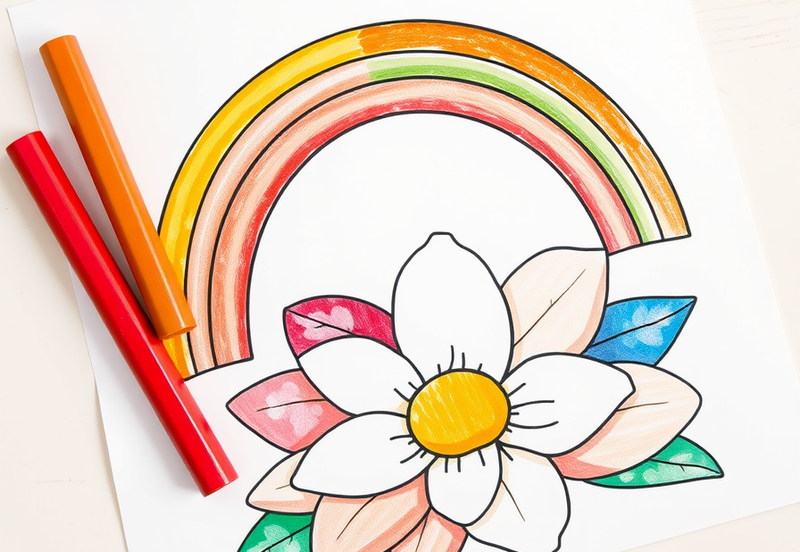
Pick subjects with large open shapes, because a one centimeter stick cannot work a narrow one. Rainbow pages are the best blending practice in the catalog, since the bands are wide and the whole point is a smooth handoff between neighbors. Easy mandalas give you repeating shapes, so you can run the same gradient five times. Flower pages and forest scenes reward scumbling, which is how you fade a petal edge or a canopy. Every page linked here downloads free as a printable PDF with no sign-up and no account, so a sheet you pill costs you a reprint rather than a loss.
Frequently Asked Questions
Can I blend oil pastels with water?
No. Water will not blend oil pastels, because the pigment sits in a mineral oil and wax binder that water cannot dissolve. A wet brush beads on the surface and lifts only a little loose pigment. Use an oil based solvent instead. Baby oil, odorless mineral spirits, and even a dab of petroleum jelly all thin the binder and move the color.
Why can't I blend my oil pastels?
The stick is almost always the problem, not your technique. Student grade sticks such as Crayola and Pentel carry more hard wax and less oil, so the mark sets firm and resists a finger. Artist grade pastels such as Sennelier and Caran d'Ache Neopastel are loaded with oil and blend under almost no pressure. Warming a hard stick in your hand for a minute helps slightly, but it will not match a soft one.
What is the rule of 3's for oil pastels?
It is not an official technique, and no manufacturer's guide uses the phrase. In oil pastel teaching it almost always means working each area in three values of one color: a light base, a mid tone, and a dark accent, blended where they meet. A few teachers use it instead for analogous color, meaning three neighboring hues on the color wheel.
What is the best paper for oil pastels?
Sanded pastel paper such as UART or Clairefontaine Pastelmat, because the grit shaves pigment off the stick and holds far more layers than a smooth sheet. If you want one paper that does everything, 140 lb cold press watercolor paper is the usual compromise. For printables, running 65 lb to 110 lb cardstock through your home printer is the practical upgrade, at a few cents a sheet.
Start Blending
Blending oil pastels depends less on your hands than on matching the method to the surface. On heavy pastel paper, blend however you like. On the 20 lb sheet most of us print on, lead with color into color and scumbling, treat solvent as one light pass, and save finger blending for small areas. Blend inward from every line and your outlines stay black.
Browse coloringden.com and print a rainbow or an easy mandala to practice a gradient on. Every page is free, printable, and downloads instantly as a PDF with no sign-up.