What Colors Make Yellow? Why You Cannot Mix It, and What to Do Instead
September 28, 2026
Key Takeaways
- No two paints or pencils mix into yellow, because yellow is one of the three subtractive primary colors alongside cyan and magenta.
- Red light and green light do combine into yellow, which is why your phone screen displays yellow without containing a single yellow subpixel.
- Adding black to yellow produces olive green rather than dark yellow, because most black pigments carry a blue undertone and blue plus yellow makes green.
- Shade yellow with yellow ochre, raw sienna, or burnt umber instead of black, and lay yellow down before any darker color because yellow pencil pigment has very low covering power.
Who this is for: Kids, parents, and beginner colorists who reached for the yellow pencil, found it missing or worn down, and want to know what actually works.
Search for what colors make yellow and you will find pages promising a tidy two color recipe. Most of them are wrong. Yellow sits at the base of the color system, so pigment cannot be built up into it the way orange or green can. That sounds like bad news until you get to the useful part. There are two yellows worth owning, there is a right way to darken yellow that nobody teaches in school, and there is a situation where red and green really do make yellow. This guide covers all three, then shows you how to lay yellow onto a printed page.
Yellow Is a Primary Color, So No Two Pigments Mix Into It
Pigments work by subtraction. A yellow pigment looks yellow because it absorbs short blue wavelengths and reflects the rest back at your eye. Add a second pigment and you absorb more light and reflect less, so the result is always darker and duller than either color you started with. Yellow is the lightest and most reflective of the primaries, so no combination of darker pigments can climb back up to it.
Your printer proves the point. Four color printing uses cyan, magenta, yellow, and black, and the yellow cartridge exists precisely because cyan and magenta cannot produce yellow between them. Mix those two and you get a blue violet. The classroom model uses red, yellow, and blue instead, and yellow is a primary there too. Either way, yellow is an ingredient rather than a result.
This also settles a question people ask constantly. Red and green do not make yellow in paint. They sit nearly opposite each other on the wheel, so mixing them cancels both and leaves brown or gray. If you tried it in a school paint tray and got mud, your paint was behaving correctly.
Red Light Plus Green Light Really Does Make Yellow
Light mixes by addition instead of subtraction, and the rules flip. Screens build every color from red, green, and blue subpixels, and there is no yellow subpixel anywhere in your phone or television. When you see yellow on a screen, the red and green subpixels both run near full brightness while the blue sits switched off. Your eye adds the two signals and reports yellow. Hold a magnifying glass to a yellow area on a bright screen and watch it break into red and green dots.
None of this helps you with a pencil, though. Paper reflects light instead of emitting it, so anything you put on paper follows subtractive rules. What colors make yellow light and what colors make yellow paint are two different questions.
The Two Yellows Worth Owning
Most beginner sets ship with a single yellow, usually a middle warm one. Once you own two, your greens and oranges improve immediately, because every yellow leans toward either green or orange.
A cool yellow leans green. Lemon yellow and Hansa Yellow Light, both sold under the pigment code PY3, fall in this group. A warm yellow leans orange, and Cadmium Yellow Deep, pigment code PY35, is the classic example. Cadmium yellows come in a Light, Medium, and Deep range that runs from cool to warm.
That bias decides what your mixtures look like:
- Cool yellow plus a greenish blue gives a bright clean green.
- Warm yellow plus blue gives a muted olive, because the orange hiding inside it brings red along, and red plus blue pulls toward violet.
- Warm yellow plus red gives a vivid traffic cone orange.
- Cool yellow plus red gives a duller, browner orange, because the green bias fights the red.
If you buy one extra pencil this year, buy a lemon yellow. It unlocks clean greens.
How to Darken Yellow Without Turning It Green
Reach for black to make a dark yellow and you get olive green instead. Black pigment is not truly neutral. Most blacks carry a blue undertone, and blue plus yellow makes green, so that hidden blue takes over. Roughly equal parts yellow and black land in olive, while a mix weighted toward yellow stops earlier at golden brown or mustard. Gray is no better and flattens yellow into a dead khaki.
The fix is to darken yellow with warmth. Yellow ochre, raw sienna, and burnt umber all deepen yellow while keeping it recognizably yellow, because they are themselves yellow pigments shifted toward brown. For the shadow side of a yellow object, layer orange first, then touch only the deepest crease with a red brown. Your eye reads that as yellow in shadow, which is the illusion you want.
Lightening is the opposite problem. Yellow is already the lightest hue on the wheel, so there is almost no headroom above it. On white paper you lighten it by pressing more gently and letting the paper show through, not by adding white.
Laying Yellow Onto a Printed Coloring Page
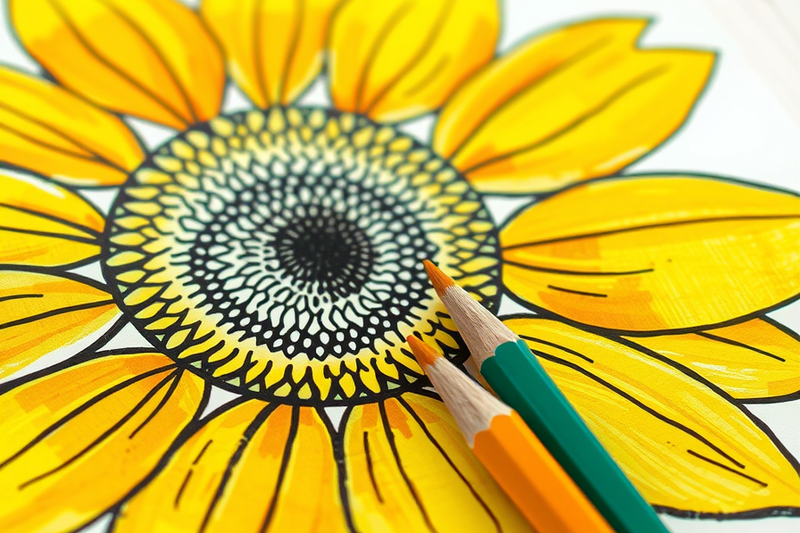
Yellow colored pencil has poor covering power next to darker pigments, and this one fact ruins more coloring pages than any mixing mistake. Yellow over a finished brown or green does almost nothing. Yellow laid down first, then covered with light passes of orange and brown, glows through everything above it. So work light to dark, always. On a sunflower, cover the whole petal in even yellow, bring orange in at the base, then put a red brown only in the deepest fold.
Some pages train specific yellow problems. Bee coloring pages force you to keep yellow clean against black, the hardest edge on the wheel. Sun mandala coloring pages give you concentric bands to grade from cool lemon at the center to warm gold at the rim. Giraffe coloring pages set a large yellow field against brown patches, so you can practice ochre instead of black. Fall coloring pages run warm yellow into orange across a leaf. Rainbow coloring pages put yellow in its hardest spot, between green and orange, where a wrong bias shows instantly. Every page on ColoringDen downloads free as a printable PDF with no sign-up and no account, so print one sheet three times and try a different approach on each.
Frequently Asked Questions
How do you make yellow if you don't have yellow?
You cannot mix a true yellow, so borrow it from pigments that already contain some. Layer a yellow leaning green lightly over a yellow leaning orange and the overlap reads as a dull yellow, because yellow sits inside both parents. Fluorescent green works best. Expect something muted, never bright. A single open stock colored pencil usually costs under three dollars and solves it properly.
Do orange and white make yellow?
No. Orange plus white makes peach or pale apricot. White raises the lightness of a color and lowers its saturation, but it does not shift the hue, so orange stays orange and simply gets paler. Orange already sits between red and yellow on the wheel, and the only way to walk it toward yellow is to add real yellow pigment.
How is yellow color made?
Manufacturers grind yellow from pigment powder rather than mixing other colors. Cadmium Yellow, pigment code PY35, is cadmium sulfide, an inorganic compound that reached artists commercially in the mid 1800s. Hansa and azo yellows such as PY3 are synthetic organic pigments developed in the twentieth century. Yellow ochre is a natural iron oxide clay people have dug up and painted with since prehistory.
What colors make mustard yellow?
Mix yellow with a small amount of brown, or yellow with a touch of black in roughly a four to one ratio weighted toward yellow. Mustard is yellow darkened and slightly dulled while staying warm. A dab of violet, yellow's complement, does the same job. Go past about equal parts yellow and black and you cross into olive green.
Start With the Right Yellow
The honest answer to what colors make yellow is that no two colors do, and knowing that saves you from the mud recipe pages lead you into. What improves your work is owning a cool yellow and a warm yellow, darkening with ochre and sienna instead of black, and putting yellow down before anything darker touches it.
Pick a sheet with a big yellow subject and test all three ideas. ColoringDen has thousands of printable coloring pages that download free as instant PDFs with no sign-up, so browse coloringden.com and print one tonight.