What Colors Make Black? How to Mix Black for Coloring Pages
September 25, 2026
Key Takeaways
- Mixing red, yellow, and blue produces a deep muddy near-black rather than a true black, because every pigment reflects some light instead of absorbing all of it.
- The two most reliable two-color blacks are ultramarine blue with burnt umber, and a deep crimson with phthalo green. Each pair sits opposite on the color wheel, so the two colors cancel into a dark neutral.
- A mixed black beats a black straight from the box, because you can push the mix warm or cool to match the colors already on the sheet.
- Build black in three to five light layers, not one heavy press. Heavy pressure crushes the tooth of the paper, and once it is flattened the pencil stops depositing pigment.
Who this is for: Beginner and intermediate colorists who want deeper darks on printable coloring pages, and parents coloring high-contrast subjects like penguins and skeletons with their kids.
You press hard with the black pencil and the area still looks like dusty charcoal, while the artist whose work you saved to your phone got a black so deep it reads like a hole in the paper. The difference is almost never the pencil. It is that they mixed their black instead of pulling one out of the tin. Here is what actually makes black, the two mixes worth memorizing, and how to layer them so the dark stays even.
Why a Mixed Black Is Never a True Black
Color mixing on paper is subtractive. Each pigment absorbs part of the light hitting the page and bounces the rest back to your eye. Stack enough pigments that between them absorb the whole visible spectrum, and very little light returns, so you read the result as black.
The catch is that no pigment absorbs everything. Ivory Black, listed on tubes and pencils as PBk9, is made from charred animal bone. Mars Black, PBk11, is a synthetic iron oxide. Both are darker than anything you can mix, and both still reflect enough light to look gray under a bright lamp. For scale, the engineered coating Vantablack absorbs 99.965 percent of visible light, and it took a forest of carbon nanotubes to get there.
So the honest goal is not a true black. It is a dark that reads as black next to everything else on your page, and a mix hits that target better than a single pencil, because a mixed dark carries a hint of the colors around it.
The Three-Primary Black, and Why It Goes Muddy
The classic answer to what colors make black is all three primaries at once: red, yellow, and blue. Layer them in roughly equal amounts, with the blue slightly heavier, and you land on a very dark brownish gray. Most people call that muddy, and they are right. The red, yellow, and blue in a standard pencil set are not pure primaries, and a warm red leans orange, which means it already contains yellow, so the mix ends up yellow-heavy and slides toward brown.
Two adjustments fix most of it: pick the coolest red in your set, the one that looks raspberry rather than fire-engine, pick a blue that leans purple rather than green, and go light on the yellow. Even corrected this is the weakest option here, but it works with a basic eight-color kit.
Two-Color Blacks That Give You a Richer Dark
Complementary colors sit opposite each other on the color wheel, and mixing a pair neutralizes both. Push the pair far enough and you get a dark deep enough to pass for black. Painters call this a chromatic black, and it is why a mixed dark looks alive where a tin black looks dead. Two pairs are worth memorizing:
Ultramarine blue and burnt umber. The workhorse. Ultramarine is cool and transparent, burnt umber is warm and earthy, and together they cover the spectrum well enough to read as black. The advantage is control: more ultramarine gives a cool black for shadows, night skies, and metal, while more burnt umber gives a warm black for fur, hair, and wood.
Deep crimson and phthalo green. The darker of the two and the more dramatic. Red and green are true complements, so they cancel hard. Use this when you need a black that still looks rich under a lamp, such as the body of a beetle or the space behind a skull.
Test either pair in the white margin first, and judge it from arm's length, because at that distance a near-black and a black are the same thing.
How to Layer Black Without Killing the Paper
Colored pencil pigment catches on microscopic ridges in the paper called the tooth. Press hard on the first pass and you flatten those ridges, which is why later layers slide off and the area never gets darker. Three to five light passes beat one heavy one. Keep the pencil at a low angle and use the side of the point.
Paper weight matters more here than for any other color, because black means many layers. Standard printer paper is 20 lb and gives you maybe three layers before it gives up. Cardstock runs 65 lb to 110 lb and takes five or six comfortably. If you are printing pages specifically to work dark areas, print on cardstock.
Your binder changes the technique too. Prismacolor Premier pencils use a soft wax binder that lays down heavy pigment fast and burnishes to a sheen. Faber-Castell Polychromos use an oil binder that keeps a sharper point and layers further before the surface saturates. Wax reaches a deep black in fewer layers, oil gives more control over the transition into the midtones.
Lay the lighter color of your pair down first and build the darker one over it. Save burnishing for the last step, because it seals the surface and nothing goes on top afterward.
Pages to Practice Your Blacks On
Black is easiest to learn where large black shapes sit against bare white paper, so you can see instantly whether your dark is actually dark.
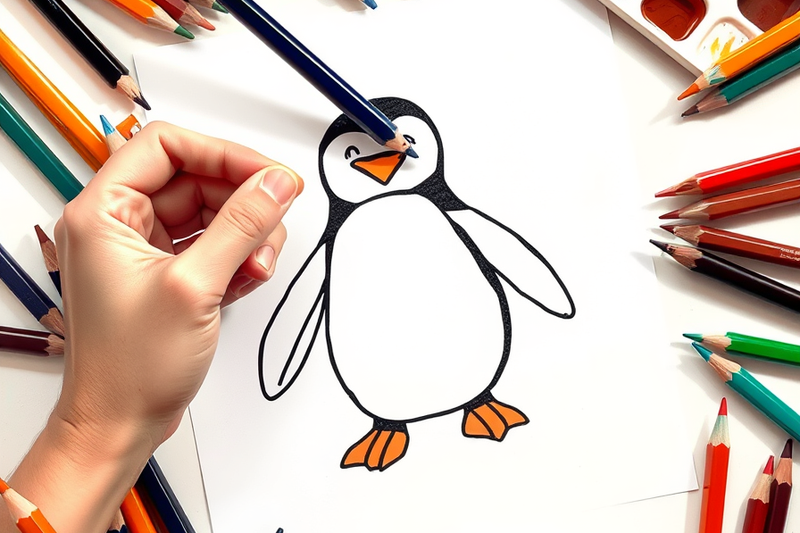
Start with penguin coloring pages, the ideal training ground because the black back meets a white belly with nothing in between. Move to skeleton coloring pages to practice black as negative space behind a pale subject. Outer space coloring pages give you large fields to fill, which is where layering either holds up or falls apart. For warm blacks, try cat coloring pages, where a black cat still needs brown and blue in the fur to read as anything but a silhouette. Ghost coloring pages are a seasonal pick where the dark surround does all the work.
Every page linked above downloads free as a printable PDF, with no sign-up and no account.
Frequently Asked Questions
Do yellow and blue make black?
No, yellow and blue make green. They are two of the three primaries, and with the third one missing there is nothing in the mix to absorb the green wavelengths, so green is exactly what bounces back. Add a red to that green and you have all three primaries, which does move you toward a dark neutral. Yellow and blue alone will never get darker than a deep forest green.
Can green and purple make black?
Partly, and it is worth knowing why. Green contains blue and yellow, purple contains blue and red, so between them the two colors do cover all three primaries. What you get is a dark, desaturated blue-gray rather than a convincing black, because the doubled blue throws the balance off. Add a touch of a warm red or burnt umber to knock the blue back and it improves fast.
How do you make black paint?
The same complementary pairs work in paint, and they work better than in pencil because you can premix on a palette and judge the result before it touches the page. Ultramarine blue with burnt umber is the standard mix in acrylic, oil, and watercolor alike. Start at roughly 1 part umber to 1 part ultramarine, then adjust warm or cool. Watercolor dries noticeably lighter than it looks wet, so mix darker than you think you need.
What does black and white make?
Black and white make gray in paint, but colored pencils do not behave that way. A white colored pencil is only semi-opaque, so laying it over black mostly burnishes the wax rather than lightening it, and you get a shiny dark gray instead of a clean one. To get gray with pencils, use your black at light pressure over bare paper, or mix a complementary pair and stop before it goes fully dark.
Start With One Mix
If you take one thing from this, take ultramarine blue and burnt umber. Two pencils, opposite temperatures, adjustable, and darker than the black in most sets. Print something with big solid shapes and lay four light layers instead of one heavy one. You will see the difference on the first page.
ColoringDen has more than 2,000 printable coloring pages to practice on, every one free to download as a PDF with no sign-up and no account. Pick a page with real darks in it and go mix a black worth the paper.