Halloween Colors: 6 Palettes That Make Coloring Pages Pop
October 12, 2026
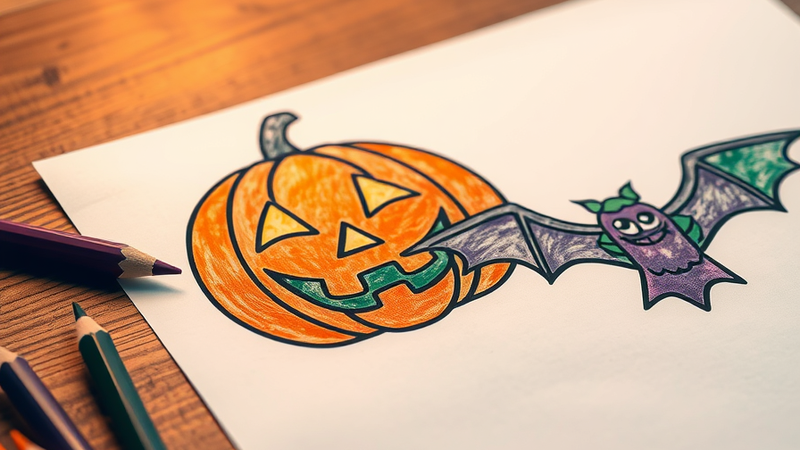
Key Takeaways
- Orange and black are the two traditional Halloween colors, and purple, poison green, and bone white are the three additions that do most of the work in modern Halloween art.
- A Halloween page looks deliberate when you limit yourself to three or four colors and repeat them across the whole sheet instead of giving every object its own hue.
- Three to five light layers of orange hold more pigment than one heavy pass, because pressing hard crushes the tooth of the paper and leaves nothing for the next layer to grab.
- Never lay black over a finished color to darken it. Layer indigo or dark violet underneath first, then let a thin pass of black sit only in the deepest shadows.
Who this is for: Kids, parents, and adult colorists who want their Halloween coloring pages to look designed instead of accidental.
Every October the same thing happens at the kitchen table. Somebody grabs the orange pencil, fills the pumpkin solid, reaches for black, and the page comes out muddy instead of spooky. The problem is almost never the artwork. It is the palette, and the order you put it down in.
Halloween has a narrow, instantly recognizable color identity. This guide gives you six palettes with hex codes, the layering order that keeps orange and black from going flat, and which palette to reach for depending on what you are coloring.
6 Halloween Color Palettes, With Hex Codes
Each palette below holds three or four colors. Pick one per page and resist adding a fifth. That restraint is what makes a sheet read as Halloween instead of as a generic autumn scene.
1. Classic Trick or Treat. Pumpkin orange #F4761F, ink black #121212, bone white #F2EDE4. The default, for good reason. Use it on jack-o-lanterns and candy buckets.
2. Haunted House. Deep purple #4B2E83, poison green #76B041, charcoal #2B2B2B. Purple and green read as supernatural rather than merely seasonal. The association is partly practical: fluorescent green and violet are the pigments that glow under a blacklight, which is why party decor leans on them.
3. Vintage Halloween. Burnt orange #C75B12, mustard #D9A528, faded teal #4F7C7A, cream #EFE3C8. The mid-century die-cut decoration look. Everything is slightly desaturated, so keep pressure light and let paper show through.
4. Moonlit Night. Midnight blue #16213E, pale moon #E8E3C8, slate gray #6B7280. Blue sits directly opposite orange on the color wheel, which is why a blue night sky makes an orange pumpkin look brighter than a black sky ever will.
5. Pastel Halloween. Soft peach #FFD3B0, lavender #CDB4F6, mint #B8E6CE, pale gray #E5E5E5. The friendly version, for toddlers and for anyone who wants cute over creepy.
6. Bone and Blood. Deep crimson #8B1A1A, bone #EDE4D3, near black #1A1A1A. The grown-up palette. Three colors, maximum contrast, nothing softened.
How to Keep Orange and Black From Going Flat
Orange is the hardest Halloween color to use well, because most sets hand you exactly one of it. A 12-count tin has one orange, so every pumpkin in the house comes out the same shade. You get range by layering, not by buying a bigger tin.
Start with a light pass of yellow across the whole shape. Add orange over it in three to five light layers, building pressure gradually rather than bearing down once. Then warm the shadow side with a thin layer of red and cool the lit side by leaving more yellow visible. That single pencil now reads as four or five distinct values. Pressing hard on the first pass does the opposite. It crushes the paper tooth, the tiny fiber peaks pigment catches on, and the next layer slides off into a waxy shine.
Black is the other trap. Black colored pencil is nearly opaque, so dragging it over finished orange does not deepen the orange, it kills it and leaves a gray cast. Build your darks underneath instead. Put indigo, dark violet, or deep brown down first, keep the color above it thin, and save true black for the narrowest shadows and the outlines. A jack-o-lantern mouth is one of the few places a solid black fill genuinely helps, because the contrast is the whole point.
For a smooth finish, burnish with a colorless blender or a white pencil at firm pressure. Do it last, because a burnished area will not accept much more color.
Match the Palette to What You Are Coloring
Pumpkins want Classic Trick or Treat or Vintage Halloween. Keep the body warm and push the stem toward green or brown so it separates from the orange. Our pumpkin coloring pages and the broader fall collection both suit it.
Ghosts need a dark background to exist at all. A ghost left white on white paper disappears, so take the Moonlit Night palette, fill the sky, and let the bare paper be the ghost. It is the rare case where the best decision is to leave a shape untouched. Try it on the ghost coloring pages.
Witches and monsters belong to Haunted House. Purple and poison green carry the supernatural read, and charcoal keeps the green from reading as spring garden. Use it on witch coloring pages or monster coloring pages.
Sugar skulls and detailed adult sheets suit Bone and Blood, or go the opposite way and use every color at full saturation, which is the traditional Dia de los Muertos approach. Both work on the skull and sugar skull pages. Every page linked here is free, printable, and downloads instantly as a PDF with no sign-up and no account.
Paper and Pencils That Hold Halloween Colors
Halloween palettes lean dark, and dark palettes punish thin paper. Standard printer paper is 20 lb. Cardstock runs 65 lb to 110 lb. If you plan on four or five layers plus a saturated night sky, print on cardstock, because 20 lb paper buckles under that much pigment and shows color through from the back.
Binder type matters more than price. Prismacolor Premier pencils use a wax binder, which lays down soft and blends easily but builds a pale film called wax bloom after a few days. Faber-Castell Polychromos use an oil binder, which stays crisp, holds a sharp point for fine detail like spider legs and bat wings, and does not bloom. For a page with both broad orange fills and thin black linework, a wax pencil for the fills and an oil pencil for the detail behaves best.
One more thing: standard colored pencils will not blend with water, because their pigment sits in a wax or oil binder that water cannot dissolve. Only pencils sold as watercolor pencils do that. A wet brush on a regular page just dents the paper.
Frequently Asked Questions
What colors are Halloween colors?
Orange, black, purple, green, and bone white are the five colors that define Halloween. Orange and black are the traditional pair, purple and green arrived through twentieth century decorations and glow-in-the-dark products, and bone white covers skulls, skeletons, and ghosts. Deep crimson is a common addition for anything gory.
Why are orange and black Halloween colors?
Both trace back to Samhain, the Celtic festival at the end of the harvest that Halloween grew out of. Orange stood for the harvest itself, the ripe crops and turning leaves of late October. Black stood for the dark half of the year that began the next day, and for death. Orange on black is also one of the highest contrast pairings available, which is why warning signs use it too.
What are the Halloween colors for 2026?
No organization designates an official Halloween color each year the way Pantone designates a Color of the Year, so any list claiming the 2026 Halloween colors is somebody's trend forecast rather than a standard. The reliable answer is that orange and black never move. The two directions showing up most in recent decor are muted vintage palettes built on burnt orange and mustard, and all-black monochrome schemes with one accent color.
How do you make black with colored pencils?
Layer dark blue, dark brown, and dark green over each other at medium pressure, which produces a richer near black than a black pencil alone. Mixing complementary pairs works too, such as deep purple over mustard yellow. A mixed black carries a color temperature you can control, while a single black pencil always reads slightly gray and flat once it is on paper.
Keep the Halloween Palette Going
Pick one of the six palettes, print on cardstock, build your orange in light layers, and keep black underneath rather than on top. Those four habits will do more for your Halloween pages than any new pencil set.
For sheets to practice on, the Halloween collection brings the whole holiday together, and the bat, spider, and skeleton pages give you plenty of black linework to test the layering order on. Every coloring page on ColoringDen is free and printable, downloads instantly as a PDF, and never asks you to create an account. Browse coloringden.com and see which palette your family keeps reaching for.